


Why India’s Healthcare Excellence Needs Better Positioning
Why India’s Healthcare Excellence Needs Better Positioning At the 16th Edition of TANCARE 2025, I had the opportunity to speak about a subject that has shaped much of my work in healthcare branding and strategic positioning. My core message was simple: India does not lack capability. It lacks positioning. Over the years, I have heard remarkable statements about Indian healthcare: Indian doctors are among the best in the world. Clinical outcomes in many Indian hospitals rival global benchmarks. Chennai has emerged as one of the world’s most sought-after destinations for advanced healthcare and medical value travel. Yet despite these strengths, a fundamental question remains: Why isn’t India’s healthcare story more visible on the global stage? The challenge has never been the absence of excellence. The challenge has been the absence of strategic positioning. Excellence Alone Does Not Build Reputation Healthcare organizations often assume that quality speaks for itself. It doesn’t. Patients, investors, healthcare partners, policymakers, and international stakeholders make decisions based on perception, trust, visibility, and credibility long before they experience clinical outcomes firsthand. In today’s competitive healthcare landscape, excellence must be accompanied by a clear narrative. A hospital may have world-class outcomes. A healthcare ecosystem may have unmatched expertise. A region may be producing extraordinary medical achievements. But if those stories are not being communicated effectively, their impact remains limited. https://www.youtube.com/watch?v=trEPTy0T-cY Tamil Nadu: A Brand Waiting to Be Amplified Tamil Nadu has built one of the strongest healthcare ecosystems in India. Its strengths include: Clinical excellence across specialties Leadership in organ transplantation Advanced medical education International accreditations Ethical healthcare delivery Strong patient outcomes A thriving medical value travel ecosystem These are not merely healthcare achievements. They are powerful brand assets. The opportunity lies in transforming these assets into a compelling global healthcare narrative. The Future Belongs to Healthcare Brands That Tell Their Story Around the world, leading healthcare destinations invest heavily in branding, reputation management, thought leadership, and strategic communication. They understand that visibility creates trust. Trust creates preference. And preference drives growth. India—and particularly Tamil Nadu—has all the ingredients needed to become a globally recognized healthcare destination. What is required now is a stronger commitment to positioning, storytelling, and brand building. Moving the Conversation Forward As healthcare leaders, our responsibility extends beyond delivering exceptional care. We must also ensure that the world understands the value we create. The future of healthcare leadership will belong not only to those who achieve excellence but also to those who communicate it effectively. It is time to take Tamil Nadu’s healthcare story—and India’s healthcare story— from clinical excellence to global recognition,from healthcare delivery to healthcare leadership,and from local success to global influence.
Doctor Branding in India: How Doctors Can Build a Personal Brand That Attracts Patients

Doctor Branding in India: How Doctors Can Build a Personal Brand That Attracts Patients Opening I have mentored hundreds of doctors across South India over the past two decades. The most gifted clinician I ever worked with was a hepatologist in Chennai — exceptional diagnostic instincts, published research, genuinely better outcomes than most of his peers in the city. His consultation waiting time when I first met him was four days. A less experienced colleague practicing three kilometres away had a six-week waiting list. The difference was not clinical skill. It was not even experience. It was visibility and perceived authority in the community. Doctor personal branding in India is still a subject that makes many physicians uncomfortable. The idea of deliberately building a public profile feels self-promotional in a profession where modesty is considered a virtue and where the NMC guidelines on medical advertising create genuine uncertainty about what is permissible. So most doctors do nothing. They rely entirely on word of mouth and hospital affiliation, and they wonder why their schedule is not as full as they know it should be. I want to address this discomfort directly. Building a personal brand as a doctor is not self-promotion. Done correctly, it is service. It is making your expertise findable by the patients who need it most, before they end up with someone less qualified. That reframe changes everything about how the work gets done. The Real Problem The standard advice given to doctors who want to attract more patients goes like this: be active on social media, post health tips regularly, get a professional website, and ask patients to leave Google reviews. This advice is not entirely wrong. But it misses the deeper issue entirely — and following it without a foundation produces the same result as hospital marketing without strategy. Noise without signal. The real problem most doctors in India face is not that they are invisible. It is that they are undifferentiated. Patients searching for a cardiologist in Hyderabad, a gastroenterologist in Coimbatore, or an orthopedic surgeon in Kochi are not just looking for someone with the right qualification. They are looking for a specific kind of trust — the sense that this particular doctor understands their specific concern, has genuine expertise in the relevant area, and is the kind of person who will communicate with them honestly. Generic health tip posts do not create that trust. A website with a list of services and qualifications does not create it either. What creates it is a specific, consistent, authentic presence in the spaces — online and offline — where your target patients are forming their healthcare opinions. Here is the assumption I want to challenge: most doctors believe patients choose them because of their qualifications. In Indian healthcare, qualifications are the baseline expectation, not the differentiator. Patients choose doctors they trust. And trust is built through familiarity, consistency, and the perception of genuine expertise communicated in a language patients actually understand. The bold truth is this: in 2026, an average doctor with a strong personal brand will see more patients than an excellent doctor with no brand. That is uncomfortable. It is also demonstrably true across every market I have worked in across South India. The Doctor Personal Branding Framework: Five Layers That Build Patient Trust Layer 1: Define Your Clinical Identity — Who You Are For The first step in doctor personal branding in India has nothing to do with social media or websites. It is an internal clarity exercise: who is the specific patient you are most qualified and most motivated to serve, and what is the specific clinical problem you are most equipped to solve? Most doctors resist this question because it feels like narrowing. It is actually the opposite. A neurologist who positions themselves as the specialist for complex migraine diagnosis in Chennai does not lose general neurology patients. They become the undisputed first choice for every patient with treatment-resistant migraine in the city — and those patients refer others who match the same profile. Specificity is the mechanism of authority. A doctor who is known for something specific is trusted more deeply and referred more actively than a doctor who is available for everything. Your clinical identity answers three questions precisely: what condition or patient population do you treat best, what makes your approach or outcomes specifically different, and what would a GP say about you when recommending you to a patient who needs exactly what you offer? Layer 2: Build Offline Authority Before Online Visibility This is the layer most doctor branding guides skip entirely because it does not fit into a social media strategy deck. And it is the most important layer for Indian doctors in Tier 2 markets and smaller cities. Offline authority means being a recognized clinical voice in your geography before you are a visible digital presence. It means speaking at GP education sessions in your specialty. It means being the doctor that a senior physician in your hospital mentions when a colleague asks who to trust for a difficult case. It means being present at local medical association meetings — not passively, but as someone with something worth saying. This kind of authority cannot be manufactured online and imported offline. It must be built in the physical community first. Once it exists, digital visibility amplifies it. Without it, digital visibility produces followers but not patients — because patients in India, particularly outside metros, make healthcare decisions based on human testimony, not social media impressions. Layer 3: Create Content That Demonstrates Expertise, Not Just Information When a doctor is ready to build an online presence, the most common mistake is producing generic health information — tips about diabetes management, monsoon health advice, World Heart Day posts. This content is not wrong. It is simply indistinguishable from every other doctor’s feed. Content that builds doctor personal branding in India does something different. It demonstrates the specific way you think, the specific knowledge you hold, and the
Why Your Hospital Is Losing Patients to Competitors — And How to Stop It

Why Your Hospital Is Losing Patients to Competitors — And How to Stop It Opening A hospital administrator in Madurai called me a few years ago with a problem he described as a “marketing issue.” His hospital had been operating for eleven years. It had a good name in the district. Three years prior, a new 80-bed competitor had opened three kilometres away — newer building, more aggressive digital presence, slightly lower consultation fees. Since then, his OPD numbers had dropped 22%. He wanted to know which agency he should hire. I told him the agency could wait. First I wanted to understand exactly why his hospital was losing patients to this competitor — not what he assumed was happening, but what the data and the patients were actually saying. When a hospital starts losing ground to a competitor in India, the instinct is almost always to respond with more marketing. More ads. More visibility. More spend. And I understand the instinct. It feels active. It feels like a response proportionate to the threat. It is usually the wrong response entirely. Because in thirty years of working inside Indian healthcare, I have found that the reasons a hospital loses patients to competitors are almost never primarily about visibility. They are about experience, trust, and the quiet accumulation of small failures that patients remember long after the clinical outcome has been forgotten. The Real Problem Here is the assumption that causes hospital owners to misdiagnose their competitive problem: they believe patients leave because a competitor is better marketed. Sometimes that is partially true. But in the Indian healthcare context — particularly in Tier 2 cities and semi-urban markets where I have done most of my work — patient attrition almost always has a more uncomfortable cause. Patients do not leave because they saw a competitor’s Instagram ad. They leave because something happened at your hospital that they could not forgive, or because nothing happened at your hospital that made them feel they should stay. The distinction matters enormously. If the problem is marketing, the solution is marketing. If the problem is experience or trust, additional marketing spend accelerates the problem by bringing in new patients who then have the same poor experience and tell more people about it. I have watched this play out at hospitals in Chennai’s suburbs, in coastal Andhra Pradesh, in smaller cities in Karnataka. A hospital that is genuinely losing competitive ground almost always has the same cluster of problems: a front desk that treats patients as a processing task, a billing experience that feels adversarial, a discharge process that leaves patients uncertain and unheard, and a GP referral network that has quietly shifted its loyalty to the competitor. The bold truth I need to state directly: most hospitals that are losing patients to competitors are not losing them because the competitor is doing something dramatically better. They are losing them because the competitor is doing the basics more consistently. And consistently is the key word. Six Reasons Your Hospital Is Losing Patients to Competitors — And What to Do About Each Your First Impression Is Losing the Decision Before It Begins In Indian healthcare markets, patient decisions are increasingly made before a visit — through Google reviews, through family recommendations, and through the first interaction with your hospital, whether that is a phone call, a WhatsApp message, or a website visit. If your Google reviews show an average of 3.8 stars while your competitor shows 4.4, you are losing patients before they ever speak to a doctor. If your phone inquiry goes unanswered between 1pm and 4pm and your competitor answers immediately, you are losing patients in that gap. The fix is not glamorous. It is an inquiry audit — tracking every inbound contact point for two weeks, measuring response time and conversion rate, and fixing the gaps. A hospital that answers every call within three rings and responds to every WhatsApp inquiry within 20 minutes has a competitive advantage that most hospitals in India have not yet claimed. Your Billing Experience Is Destroying Trust This is the single most underestimated driver of patient attrition in Indian hospitals. Billing. Patients in India are deeply sensitive to pricing transparency. When a patient receives a final bill that is significantly higher than the estimate they were given — with line items they do not understand and nobody willing to explain them — the clinical outcome becomes irrelevant. The emotion they walk out with is betrayal. And they tell everyone. I worked with a hospital in Tamil Nadu where the clinical feedback was consistently positive and the billing complaints were consistent and ignored. Once we implemented pre-treatment cost estimates as a standard protocol and trained billing staff to walk patients through their invoices line by line, complaints dropped 60% in four months. Referrals from discharged patients increased measurably within six months. Billing transparency is a competitive differentiator in Indian healthcare in 2026. Most hospitals have not recognised this yet. The ones that have are quietly taking market share from those that have not. Your Doctors Are Visible Inside Your Hospital But Invisible Outside It In the competitive Indian healthcare market, a doctor’s personal reputation in the community is often more powerful than the hospital’s brand. Patients in Coimbatore or Visakhapatnam or Bhubaneswar choose hospitals because they trust a specific doctor — not because the hospital has a compelling tagline. If your doctors are excellent clinicians but invisible community figures, you are giving competitors with more publicly present doctors an unnecessary advantage. This does not require your doctors to become social media personalities. It requires them to be present in the community in credible, clinical contexts — speaking at local health events, contributing to GP education sessions, being the name a GP mentions when a patient needs a referral. That kind of visibility is built through consistent engagement over 12 to 18 months. It cannot be bought overnight. But hospitals that invest in it systematically retain competitive advantage that
The Complete Hospital Branding Guide for Indian Hospital Owners in 2026
The Complete Hospital Branding Guide for Indian Hospital Owners in 2026 Opening When I joined Apollo Hospitals in 1993, the word “branding” was not part of the vocabulary inside most Indian hospitals. Clinical excellence was the only currency that mattered. The idea that a hospital might need to think deliberately about how it was perceived — what it stood for, how it made patients feel, what story it told about itself — was considered at best unnecessary and at worst slightly embarrassing. Thirty years later, I watch hospital owners in Chennai, Hyderabad, and smaller cities across South India spend lakhs on logos, websites, and taglines while their brand — the actual thing patients experience — remains confused, inconsistent, and forgettable. The confusion is understandable. Hospital branding in India is a misunderstood subject. Most people who talk about it are talking about design. Most hospitals that invest in it are investing in visuals. And most of that investment produces very little return because it is solving the wrong problem. A hospital brand is not your logo. It is not your colour palette. It is not even your tagline. It is what a patient in your catchment area believes about you before they ever walk through your door — and what they say about you after they leave. That belief is built over time through every interaction, every staff member, every doctor’s behaviour, every billing conversation, and every post-discharge experience. This guide is about building that. Not the visual surface. The actual brand. The Real Problem The most common mistake Indian hospital owners make with branding is treating it as a one-time creative project rather than an ongoing operational discipline. They hire a design agency. The agency produces a new logo, a refreshed colour scheme, a mission statement that could belong to any hospital in the country, and a website with stock images of smiling doctors. The owner approves it, launches it with some social media posts, and waits for the brand to start working. It does not work. Because none of it was built on anything true or specific about that hospital. Here is what I have seen in thirty years of working with hospitals across South India: the hospitals with the strongest brands did not start with a visual identity exercise. They started with a brutal honest answer to three questions — what are we genuinely better at than anyone within 20 kilometres of us, who is the specific patient we exist to serve, and what do we want someone to say about us when they are recommending us to a family member? Most hospitals cannot answer those questions precisely. And when you cannot answer them precisely, no agency can brand you effectively — because branding is the art of communicating something specific and true. If the truth has not been defined, the communication will be generic. The bold statement I want to make clearly: a new logo does not build a hospital brand. Consistent patient experience does. And no amount of design investment compensates for an inconsistent or mediocre patient experience. The Hospital Brand Strategy Framework: Five Layers That Actually Matter Layer 1: Brand Foundation — What Is Actually True About You Before any visual or communication work begins, a hospital must define its brand foundation. This is an internal exercise, not an external one — and it must be ruthlessly honest. Brand foundation covers four elements: Your genuine clinical differentiator — not what you wish were true, but what your patient outcome data, your specialist roster, and your community reputation actually support. A 60-bed hospital in a Tier 2 city in Tamil Nadu that has an exceptional diabetologist on staff has a genuine differentiator. A hospital that offers “comprehensive multi-specialty care” does not, because every hospital says the same thing. Your defined patient segment — the specific population your hospital is best equipped to serve. This does not mean excluding anyone. It means understanding who you are most relevant to, so your positioning speaks directly to them. A hospital near an industrial corridor in Andhra Pradesh has a different primary patient segment than a hospital adjacent to a residential area with a large elderly population in Kerala. Your brand promise — the one thing a patient should always experience, without exception, every time they interact with your hospital. Not a tagline. A behavioral commitment. “Every patient leaves knowing exactly what happens next” is a brand promise. “Compassionate care” is a phrase. Your proof points — the specific, verifiable evidence that your brand promise is real. Patient testimonials with specific outcomes. Recovery time data for key procedures. Staff tenure and training credentials. These are what convert brand claims into brand trust in the Indian healthcare context. Layer 2: Brand Expression — Translating Truth Into Communication Once the foundation is defined, visual and verbal expression follows naturally. This is where most hospitals start. It is actually the second step. Effective hospital brand expression in India requires addressing three distinct audiences simultaneously: patients making a first-time decision, GPs who are potential referring partners, and the local community whose ambient perception shapes your reputation before any individual decision is made. Each audience responds to different signals. Patients respond to clarity, warmth, and evidence of competence — staff behaviour, facility cleanliness, wait time communication, and how the front desk makes them feel in the first three minutes. GPs respond to clinical credibility and professional respect — the quality of your specialist communications, the speed of discharge summaries, and whether your doctors treat them as partners rather than referral sources. The community responds to consistent, long-term visibility — health camps, school programs, local sponsorships, and the reputation of individual doctors within the community. A hospital brand that speaks effectively to all three audiences does not require three different visual identities. It requires one clear identity applied consistently across all three contexts. Layer 3: Brand Delivery — Where the Brand Is Actually Built This is the layer most hospital branding guides never address. And
How to Increase Patient Walk-ins for Your Hospital Without Spending More on Ads

How to Increase Patient Walk-ins for Your Hospital Without Spending More on Ads I remember walking into a 75-bed hospital in a mid-sized town in Tamil Nadu where the administrator proudly showed me their monthly ad spend — ₹1.8 lakh across Google, Facebook, and a local cable television slot. Then he showed me the OPD register. Footfall had actually dropped 12% over the previous six months despite the increased spending. We spent the next hour talking to the front desk staff, the security guard at the entrance, and three patients waiting in the OPD queue. By the end of that hour, the problem was completely clear. And not one part of it had anything to do with advertising. If you are trying to increase patient walk-ins for your hospital in India and your first instinct is to increase your ad budget, I want to slow you down. Not because advertising does not work. It does, when the fundamentals are right. But in thirty years of working inside Indian healthcare — from Apollo Hospitals to independent nursing homes across South India — I have rarely seen a footfall problem that more advertising alone could solve. The patients are out there. The question is why they are not walking through your door. And the answer is almost always found closer to home than any agency dashboard will show you. The Real Problem The standard advice for increasing hospital patient footfall goes something like this: improve your Google My Business listing, run targeted Facebook ads, post more health content on Instagram, and invest in search engine optimization. That advice is not wrong. But it is dangerously incomplete for the Indian healthcare context — and following it without addressing what is happening inside your hospital first is like painting the front door of a house that has a broken foundation. Here is what most hospitals in India do not want to acknowledge: the majority of patient footfall problems are not marketing problems. They are trust problems, referral problems, and experience problems. And no amount of digital spend repairs any of those. Consider this. In semi-urban Tamil Nadu, Kerala, and Andhra Pradesh, the single most powerful driver of hospital choice is still word of mouth — either from a trusted GP or from a family member who has been treated at the hospital before. A patient in Tirunelveli choosing between two hospitals of similar size is not making that decision based on which one has a better Instagram page. They are making it based on what their neighbour said, what their family doctor recommended, or what they heard at the temple last Sunday. That is the real acquisition channel. And it runs entirely on reputation, relationships, and experience — none of which can be purchased through an ad platform. The bold truth is this: hospitals that have cracked organic patient growth in India have not outspent their competitors. They have out-trusted them. Five Ways to Increase Patient Walk-ins Without Increasing Your Ad Spend Fix What Happens in the First Five Minutes The most powerful patient acquisition tool your hospital has is the experience of every patient who walks through your door today. Because in Indian healthcare, one patient’s experience typically influences the decisions of 8 to 15 people in their immediate social network — family, friends, colleagues, neighbours. I have audited hospitals where the clinical care was genuinely excellent and the marketing was failing. In almost every case, the front desk experience was the problem. Patients waited 25 minutes to register. Staff were indifferent. The OPD queue system was chaotic. Nobody acknowledged that a first-time patient might be anxious. Fix the first five minutes and you fix your most powerful marketing channel. This means: a warm, efficient registration process, clear signage, a designated person to orient new patients, and a system that communicates wait times honestly. These cost nothing beyond intention and training. Their impact on referral generation is immediate. Build a Structured GP Referral Program In South India, GP referrals are the arterial system of hospital patient flow. Yet most hospitals treat their GP relationships casually — a Diwali gift here, an occasional phone call there, a sponsored CME once a year if the budget allows. That is not a referral program. That is relationship maintenance at minimum viable effort. A structured GP referral program means knowing exactly which GPs in your 10-kilometre catchment area are active referrers, which ones referred patients in the past but have stopped, and which ones have never referred but serve a patient population that matches your specialties. It means scheduling quarterly clinical engagement sessions where your specialists share genuine clinical knowledge — not promotional content — with these GPs. It means creating a simple, respectful feedback loop where a GP who refers a patient receives an update on that patient’s outcome. That one practice alone, done consistently, builds more referral loyalty than any advertising campaign. I worked with a hospital in Coimbatore that increased active referring GPs from 22 to 61 over 14 months purely through structured engagement — no gifts, no commissions, nothing that would raise a compliance concern under NMC guidelines. Monthly OPD registrations grew by 38% in that period. Activate Your Discharged Patient Base Every patient your hospital has ever discharged is a potential ambassador — or a lost opportunity. Most hospitals treat discharge as the end of the relationship. It should be the beginning of the retention and referral phase. A simple post-discharge follow-up protocol — a phone call at day 3, a WhatsApp message at day 10, a reminder for the follow-up consultation at day 30 — does three things simultaneously. It catches any post-discharge concerns before they become complaints. It demonstrates that the hospital genuinely cares about outcomes, not just billing. And it keeps the hospital present in the patient’s mind at exactly the time when family members and friends are most likely to ask them for a healthcare recommendation. The cost of this program is one trained staff member and
A New Chapter: Why I Said Yes to Leading the Next Generation of Healthcare Marketers
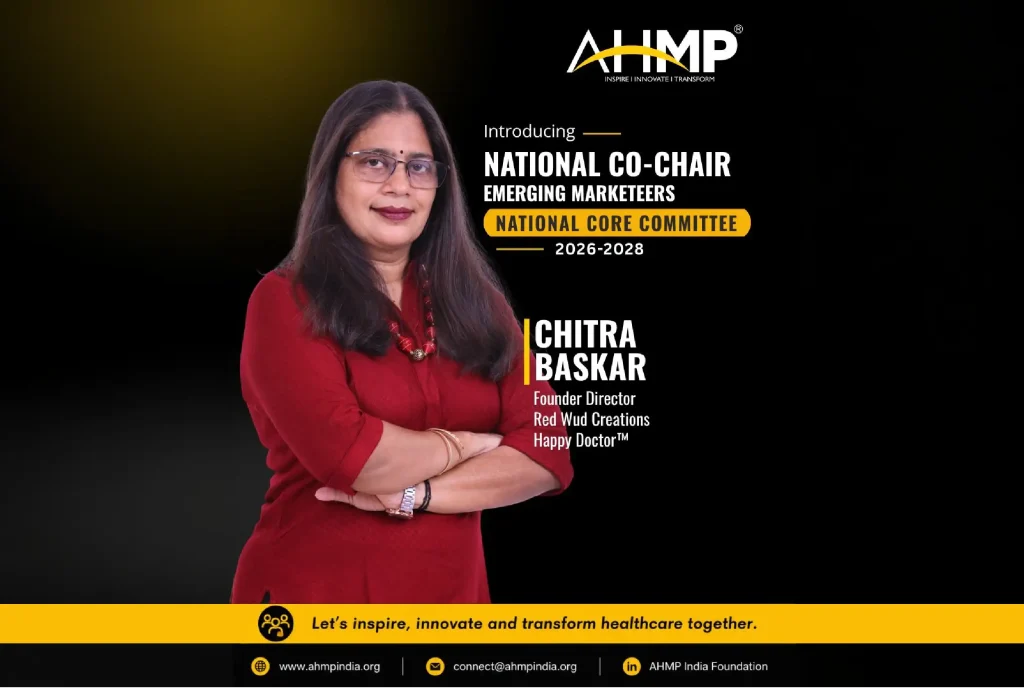
A New Chapter: Why I Said Yes to Leading the Next Generation of Healthcare Marketers There are moments in a career that feel like a natural continuation of everything you have built — and moments that feel like an invitation to build something entirely new. This appointment is both. I am honoured and deeply grateful to have been appointed National Lead – Emerging Marketeers on the AHMP India National Core Committee for 2026–2028. When the Association of Healthcare Marketing Professionals India extended this responsibility to me, my answer was immediate. Because if there is one thing thirty years in this industry has taught me, it is this: the future of healthcare marketing will not be decided by those of us who have already built our careers. It will be decided by the professionals we invest in today. And that investment is now my primary responsibility. What AHMP India Means to Me The Association of Healthcare Marketing Professionals India stands for something I have believed in throughout my career — that healthcare marketing must be practised with purpose, intelligence, and an unwavering commitment to patient trust. AHMP’s vision to Inspire, Innovate, and Transform healthcare marketing is not a tagline for me. It is a description of the work I have been doing since I founded Red Wud Creations and later created Happy Doctor. It is the philosophy that has guided every hospital brand I have built, every communication framework I have developed, and every marketing professional I have had the privilege of mentoring. Being part of the National Core Committee for 2026–2028 is an opportunity to carry that philosophy beyond my own client work and into the broader professional community. It is an opportunity to help shape not just individual careers but the standards, values, and capabilities of an entire generation of healthcare marketers. That is a responsibility I do not take lightly. The Role: National Lead – Emerging Marketeers The mandate of this role is clear and it is one I find genuinely exciting. As National Lead – Emerging Marketeers, my focus will be on three groups of professionals who represent the future of our discipline: students who are just beginning to discover healthcare marketing as a career path, young professionals in their early years who are navigating the unique demands of this sector, and mid-level marketers who have the ambition and the foundation to step into senior leadership roles. My work will be to create the platforms, the learning opportunities, the mentorship structures, and the professional community that these individuals need to grow with confidence, clarity, and purpose. This is not about delivering lectures or conducting occasional workshops. It is about building something that lasts — a genuine pipeline of healthcare marketing talent that will serve this industry, and ultimately serve patients, for decades to come. Why the Next Generation Needs a Different Kind of Preparation I want to be honest about something. Healthcare marketing is one of the most demanding professional disciplines you can choose. It sits at an intersection that very few sectors can match — where commercial strategy meets human sensitivity, where creativity must be held in careful balance with clinical accuracy, and where every message you craft has the potential to influence a patient’s most important decisions. That is not something you learn from a textbook or a digital marketing course. It is something you learn from experience, from mentorship, and from a professional community that takes these responsibilities seriously. When I look at the emerging healthcare marketing talent in India today, I see enormous potential. I also see a gap — a gap between the enthusiasm and capability these young professionals bring and the structured guidance, real-world exposure, and industry mentorship they need to realise that potential fully. Closing that gap is what this role is about. Through my work at Red Wud Creations, I have spent three decades building strategic communication and brand positioning frameworks for 400+ hospitals and healthcare brands across India. Through Happy Doctor, I have worked to humanise healthcare communication at the level of the individual physician — helping doctors find their authentic professional voice so that patients experience both clinical expertise and genuine human connection. Both of these journeys have given me a deep understanding of what healthcare marketing demands at its best. And both have confirmed something I have always believed: the professionals who thrive in this space are those who understand not just how to market, but why responsible, patient-centred marketing matters. That understanding is what I intend to pass on. What I Will Bring to Emerging Healthcare Marketers Over the course of this committee tenure, my commitment to the Emerging Marketeers community is built around three things. The first is real-world knowledge. I will not be sharing theory. Everything I bring to this role comes from three decades of actual hospital marketing work — the strategies that drove patient acquisition, the brand frameworks that built institutional trust, the communication approaches that helped doctors connect authentically with their patients, and yes, the mistakes and course corrections that taught me more than any success ever did. The second is honest mentorship. I believe strongly that the best mentors are those who tell you what you need to hear, not just what you want to hear. Healthcare marketing is a field where professional integrity matters enormously. I will always mentor with that at the centre. The third is community. One of the most valuable things any professional can have is a strong peer network — people at different stages of their journey who share knowledge, support each other through challenges, and collaborate on ideas. Building that community within AHMP’s Emerging Marketeers vertical is something I am genuinely committed to. A Personal Word to Emerging Healthcare Marketers If you are reading this as a student considering healthcare marketing as a career, as a young professional just finding your footing in this industry, or as a mid-level marketer looking to take the next step — I want you to know
How to Build a Personal Brand as a Doctor in India — From Clinician to Thought Leader
How to Build a Personal Brand as a Doctor in India — From Clinician to Thought Leader Two surgeons with identical qualifications practice in the same city. One has a six-week waiting list. The other struggles to fill a morning OPD. The clinical difference between them is negligible. The visibility difference is significant. Doctor personal branding India specialists are increasingly recognising this reality — patients no longer choose purely on referral or proximity. They research, compare, and decide based on perceived authority and digital presence. This guide outlines how specialist doctors can build that presence deliberately, not accidentally. Why Indian Doctors Can No Longer Afford to Be Invisible Online For decades, a good reputation in Indian medicine was built entirely through peer referrals and word-of-mouth within local communities. That model still exists — but it now operates alongside a parallel system where patients Google their symptoms, watch YouTube explainers, read LinkedIn posts, and form opinions about doctors before ever calling a clinic. The challenge for most specialist doctors is that healthcare branding India-wide remains poorly understood at the individual level. Hospitals invest in institutional marketing. Individual doctors are left to navigate their own visibility — usually without strategy, time, or guidance. The result is a large population of highly qualified physicians who are invisible outside their immediate patient and peer network. In competitive urban markets — Chennai, Bengaluru, Hyderabad, Mumbai, Delhi — that invisibility has a direct cost in patient volume, referral quality, and professional opportunity. Chitra Baskar’s Framework: Four Pillars of Doctor Personal Branding Building a personal brand as a doctor is not about becoming an influencer. It is about making expertise visible to the right audiences — patients, peers, institutions, and media — in a way that builds trust over time. Chitra Baskar’s framework for doctor personal branding India specialists can apply rests on four pillars: Clarity of Positioning Every doctor needs a clear answer to one question: what do you want to be known for? Not your full qualification list — your specific area of clinical authority. A spine surgeon who positions around minimally invasive techniques for working professionals communicates far more sharply than one whose profile lists every procedure they perform. Content as Credibility Digital marketing for doctors and clinics India requires a content approach grounded in patient education, not self-promotion. Short posts that explain conditions, clarify misconceptions, or describe treatment decisions demonstrate clinical thinking and build public trust. One well-written post per week, consistently published, compounds into significant authority over twelve months. Platform Selection Not every platform serves every doctor equally. LinkedIn works exceptionally well for how to build a doctor personal brand on LinkedIn India — particularly for specialists targeting urban, educated patients and professional referrers. Instagram works for visual specialties and younger patient demographics. The mistake is trying to be active everywhere simultaneously without depth anywhere. Peer Visibility Personal branding is not only patient-facing. Speaking at CMEs, contributing to clinical publications, participating in panel discussions, and being quoted in health journalism builds the professional credibility layer that strengthens referral networks. Five Practical Steps to Start Building Your Brand This Month Step 1: Audit your current digital footprint. Search your own name and specialty on Google. What appears? An incomplete Practo profile and a hospital directory listing is not a brand — it is an absence. Understanding the gap is the starting point. Step 2: Write your positioning statement. In two sentences, define who you serve, what you specialise in, and what makes your clinical approach distinctive. This statement anchors every piece of content and communication you produce going forward. Step 3: Optimise your LinkedIn profile completely. For personal branding for specialist doctors India-wide, LinkedIn is the single highest-return platform for professional visibility. A complete headline, a clearly written summary, and regular content activity transforms a dormant profile into an active credibility asset. Step 4: Commit to one content format. Written posts, short videos, or patient explainer graphics — choose one format you can sustain and produce it consistently. Consistency over six months builds an audience that sporadic high-effort content never achieves. Step 5: Engage, do not just broadcast. Comment on peers’ posts, respond to patient questions in public forums, and participate in relevant healthcare discussions online. Visibility is built through interaction as much as through original content. Mistakes Doctors Make When Attempting Personal Branding Starting with aesthetics instead of strategy. Many doctors invest in a professional photoshoot or a redesigned website before defining what they want to be known for. Brand clarity must precede brand design — not follow it. Mixing personal and professional without intention. Healthcare content marketing India audiences respond to doctors who are human — but there is a meaningful difference between appropriate personal insight and oversharing. The line requires deliberate thought. Expecting immediate results. Personal brand building is a twelve-to-eighteen month commitment before compounding effects become visible. Doctors who post for six weeks, see no dramatic change, and stop never reach the inflection point where consistency pays off. Expertise Has Always Mattered — Now Visibility Does Too The most effective doctor personal branding India specialists build is not loud or self-congratulatory. It is clear, consistent, and genuinely useful to the patients and peers it reaches. Clinical excellence earns trust in the room — a personal brand earns it before patients ever arrive. If you are a specialist doctor ready to build a visible, credible presence and want a structured approach, Chitra Baskar works with individual physicians and surgeon-founders across India to design personal brand strategies that reflect real expertise. Connect with her on LinkedIn or book a discovery call to explore how to become a thought leader as a doctor in India on your own terms. What does a healthcare business growth consultant do? A healthcare business growth consultant helps hospitals, clinics, and healthcare entrepreneurs identify revenue gaps, streamline operations, build leadership capacity, and create clear, actionable strategies to grow their organisation sustainably and profitably. Why do healthcare businesses in India need a growth consultant? India’s healthcare sector
Patient Experience vs Patient Satisfaction — Why Indian Hospitals Confuse the Two and Pay the Price
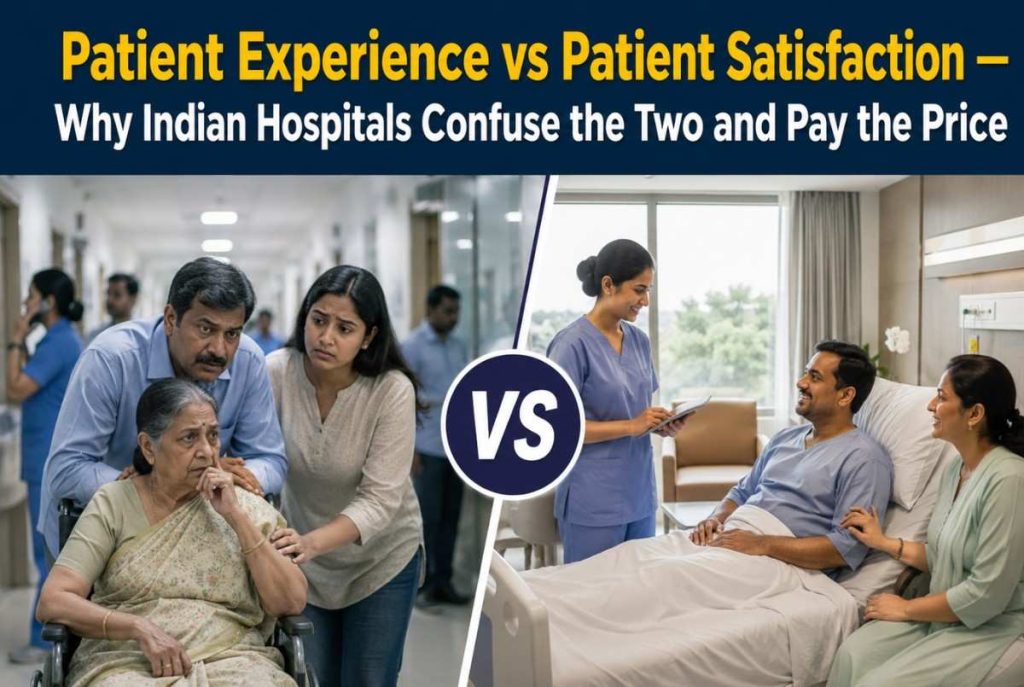
Patient Experience vs Patient Satisfaction — Why Indian Hospitals Confuse the Two and Pay the Price A patient leaves your hospital with a smile, completes a satisfaction survey with top scores, and never returns. No complaint was filed. No bad review was posted. Yet something in that care journey failed to build lasting trust. This pattern plays out across Indian private hospitals every day — and most leadership teams cannot explain it. Every skilled patient experience consultant India healthcare leaders work with will point to the same root cause: satisfaction and experience are not the same thing, and confusing them costs hospitals far more than they realise. Why Satisfaction Scores Are Giving Indian Hospitals a False Sense of Security Hospital patient satisfaction India measurements typically capture how a patient felt at discharge — whether the food was acceptable, whether staff were polite, whether the bill was explained. These are important data points. But they measure a moment, not a journey. Patient experience, by contrast, encompasses every interaction a patient has with a hospital — from the first Google search to the follow-up call three weeks post-discharge. It includes how long they waited, whether they understood their diagnosis, how safe they felt, and whether they trusted the team caring for them. A patient can score a hospital eight out of ten on a satisfaction survey and still choose a different hospital for their next procedure. Satisfaction measures contentment. Experience measures connection. Only one of those drives retention, referrals, and long-term revenue. The Framework: Understanding What Patient Experience Actually Measures Chitra Baskar’s consulting work with medical directors and quality heads across India consistently returns to a foundational distinction — satisfaction is transactional, experience is relational. Building one without the other leaves significant patient retention value on the table. Her framework maps the patient experience across five critical stages: Pre-Arrival — How easy was it to find information, book an appointment, and understand what to expect? Friction here creates anxiety before the patient even enters the building. Arrival and Reception — First physical impressions, waiting time management, and the tone set by front-desk staff. These moments disproportionately shape overall perception. Clinical Interaction — Did the patient feel heard? Was their condition explained in language they understood? Did the care team demonstrate both competence and empathy? Discharge and Transition — Was the discharge process clear? Did the patient leave knowing what to do next, who to call, and when to return? Post-Discharge Follow-Up — Did the hospital reach out proactively? This stage is almost universally neglected by Indian hospitals and represents one of the strongest patient trust building strategies India hospital teams can implement immediately. Patient engagement strategies for Indian hospitals that address all five stages consistently outperform those that focus only on in-hospital satisfaction. Patient journey mapping for hospitals India quality teams conduct is the practical tool that makes this framework actionable. Four Steps to Shift From Satisfaction Measurement to Experience Design Step 1: Replace exit surveys with journey audits. A discharge satisfaction form captures one moment. A patient journey audit maps friction, confusion, and disconnection across every touchpoint. Conduct structured interviews with recently discharged patients — not just forms — to surface what surveys miss. Step 2: Train clinical and non-clinical staff differently. Satisfaction training focuses on politeness. Experience training focuses on communication — explaining procedures, acknowledging anxiety, and making patients feel informed at every stage. The distinction matters in how training is designed and delivered. Step 3: Build a post-discharge contact protocol. A structured follow-up call within 48 to 72 hours of discharge — checking on recovery, answering questions, and confirming medication compliance — does more for patient loyalty than any lobby renovation. Understanding how to improve patient experience in Indian hospitals starts here. Step 4: Close the feedback loop visibly. When patients see that their feedback led to a visible change, trust deepens. Communicate improvements back to the community through social media, notice boards, or newsletters. This signals that the hospital listens — and acts. Mistakes That Keep Hospitals Stuck at Satisfaction Without Reaching Experience Treating NABH accreditation as the finish line. Accreditation sets a compliance baseline. It does not guarantee that patients feel genuinely cared for, understood, or valued. Hospitals that stop at accreditation miss the relational layer entirely. Measuring only what is easy to measure. Net Promoter Scores and discharge ratings are simple to collect. Emotional trust, communication clarity, and care continuity are harder to quantify — but far more predictive of patient retention. What gets measured shapes what gets managed. Assigning experience to one department. Patient experience is not the responsibility of the quality team or the marketing department alone. It is an organisation-wide discipline that requires alignment across clinical, operational, and administrative functions. Siloed ownership produces siloed results. Satisfaction Gets Patients to Leave Quietly — Experience Gets Them to Come Back The hospitals that build sustainable patient loyalty in India are not necessarily the ones with the highest satisfaction scores. They are the ones that design every stage of the patient journey with intention, empathy, and follow-through. That is what a patient experience consultant India healthcare leaders rely on helps build — not just better surveys, but better systems. If your hospital is ready to move beyond satisfaction metrics and build a patient experience framework that drives genuine retention, Chitra Baskar offers focused consulting for medical directors, quality heads, and CEOs across India. Connect with her on LinkedIn or book a discovery call to begin exploring patient journey mapping for hospitals India that creates lasting patient trust. What does a healthcare business growth consultant do? A healthcare business growth consultant helps hospitals, clinics, and healthcare entrepreneurs identify revenue gaps, streamline operations, build leadership capacity, and create clear, actionable strategies to grow their organisation sustainably and profitably. Why do healthcare businesses in India need a growth consultant? India’s healthcare sector is competitive and rapidly evolving. Many providers have clinical excellence but lack the business strategy, systems, and leadership structures to scale. A specialist consultant bridges that
Social Media for Hospitals in India — A Practical Strategy That Converts Followers Into Patients
Social Media for Hospitals in India — A Practical Strategy That Converts Followers Into Patients Most hospital social media pages in India share one thing in common — activity without outcomes. Posts go up regularly, likes trickle in, and follower counts grow slowly. But appointment inquiries stay flat. The issue is not effort — it is strategy. Social media marketing for hospitals India requires a fundamentally different approach than general brand content. This guide outlines what actually works, why most hospital pages underperform, and how to build a content system that moves patients from scroll to consultation. Why Hospital Social Media in India Is Not Working Walk through the Instagram or Facebook page of almost any private hospital in India and the pattern is familiar. Doctor introduction posts. World Health Day graphics. Facility photographs. Occasional patient testimonials. All of it posted without a conversion goal in mind. This is not a content volume problem. It is a strategy problem. Digital marketing for doctors and clinics India-wide suffers from the same root cause — content is created for visibility, not for patient decisions. There is no clear pathway from a post to an inquiry, and no content architecture designed to build trust progressively. The result is a social media presence that looks active but generates no measurable patient acquisition value. Marketing budgets get spent. Reports show reach and impressions. But the phone does not ring differently. The Framework: Content That Builds Trust and Drives Action Chitra Baskar’s approach to social media strategy for healthcare separates content into three distinct layers — each serving a different role in the patient decision journey. Together they form the foundation of effective healthcare digital marketing India hospitals can implement without a large team. Layer 1: Trust-Building Content (60% of output) This is educational, condition-specific content that answers the questions patients are already searching for. Posts that explain symptoms, debunk myths, describe treatment options, or clarify when to see a specialist — this content earns credibility and reach organically. A Facebook and Instagram strategy for Indian hospitals that leads with education performs consistently better than one that leads with promotion. Patients do not follow hospitals for updates — they follow for information they find useful. Layer 2: Credibility Content (25% of output) Doctor profiles, clinical milestones, patient outcome stories (with appropriate consent), and behind-the-scenes content that humanises the hospital. This layer answers the implicit question every prospective patient has: can I trust this place with my health? Short video introductions from consultants, procedure explainers, and staff spotlights build familiarity. Familiarity reduces hesitation. Reduced hesitation converts to inquiries. Layer 3: Conversion Content (15% of output) Direct calls to action — appointment booking prompts, free health check offers, seasonal health camp announcements, and inquiry links. This layer only works when the first two layers have done their job. Conversion content posted without trust content behind it generates almost no response. Understanding how to use social media to attract patients in India means accepting that the sale happens at Layer 3 but the decision happens across all three. Five Steps to Build a Hospital Social Media System That Works Step 1: Define one primary platform. Most hospital teams spread effort across Facebook, Instagram, YouTube, and LinkedIn simultaneously. Pick the platform where your target patient demographic is most active — for most Indian hospitals, Facebook and Instagram together — and build depth before expanding. Step 2: Create a monthly content calendar. Consistency matters more than volume. A structured social media content plan for clinics India-based teams can sustain means planning content themes weekly — one educational post, one credibility post, and one conversion prompt per week as a baseline. Step 3: Invest in short-form video. Reels and short videos consistently outperform static posts across Indian healthcare audiences. A 60-second consultant explaining a common condition, recorded on a mobile phone with clear audio, generates more trust than a professionally designed graphic. Step 4: Make the inquiry pathway frictionless. Every conversion post must have a direct next step — a WhatsApp link, a booking button, or a phone number. Removing friction between interest and contact is one of the fastest ways to improve social media ROI. Step 5: Track what matters. Reach and likes are vanity metrics. Track link clicks, shares, WhatsApp initiations, and appointment bookings attributed to social media. Without outcome tracking, there is no way to improve. Mistakes That Keep Hospital Social Media Stuck Posting without a patient persona in mind. Content created for “everyone” resonates with no one. Every post should be written for a specific patient — their age, concern, and decision context. Delegating entirely to a junior executive or agency without strategic oversight. Social media for hospitals requires clinical accuracy and brand alignment. Without senior input, content drifts into generic territory that builds no real audience. Ignoring comments and messages. Unresponded inquiries in DMs and comment sections represent lost patients. Social media is a two-way channel — responsiveness is part of the strategy, not an afterthought. Social Media Works — When It Is Built Around Patient Decisions A social media presence that converts is not built on more posts — it is built on the right structure, the right content mix, and a clear pathway from awareness to appointment. Social media marketing for hospitals India done well is one of the most cost-effective patient acquisition channels available to independent hospitals today. If you want to build a content strategy that generates real inquiries — not just followers — Chitra Baskar works with hospital marketing teams and clinic owners across India to design and implement digital strategies that deliver measurable results. Connect with her on LinkedIn or book a discovery call to explore a tailored approach to how to use social media to attract patients in India for your specific hospital or clinic. What does a healthcare business growth consultant do? A healthcare business growth consultant helps hospitals, clinics, and healthcare entrepreneurs identify revenue gaps, streamline operations, build leadership capacity, and create clear, actionable strategies to grow
How Tier 2 City Hospitals in India Can Compete with Corporate Chains
How Tier 2 City Hospitals in India Can Compete with Corporate Chains The arrival of a corporate hospital chain in a Tier 2 city does not have to signal the decline of independent healthcare. Many hospital owners respond with anxiety — cutting prices, rushing renovations, or simply hoping loyalty holds. None of these work consistently. What works is a structured clinic expansion strategy Tier 2 cities India independent hospitals can own — one that plays to their genuine strengths rather than imitating what corporate chains already do better. Why Independent Hospitals Are Losing Ground — And What Is Actually Driving It The challenge from chains of hospitals is real, but it is frequently misunderstood. Patients are not leaving independent hospitals purely because corporate facilities are clinically superior. In many cases, they are not Apollo, Fortis, and Manipal. What corporate chains offer is a packaged confidence — consistent signage, structured communication, digital convenience, and the reassurance of a nationally expanded name. Independent hospitals, despite decades of service and strong community relationships, often fail to communicate their value with the same clarity. This is fundamentally a private hospital marketing India challenge. Owners who diagnose it correctly stop trying to match corporate infrastructure and start investing in differentiated positioning that corporate chains genuinely cannot replicate at scale. The gap is not in capability or care quality. It is in how that quality is perceived, communicated, and experienced by patients at every touchpoint. The Strategic Framework: Four Advantages Independent Hospitals Must Own Chitra Baskar’s work with independent hospitals across Tier 2 and Tier 3 cities consistently identifies four areas where independent owners hold structural advantages — if they choose to develop them intentionally. Proximity and Personalised Care Corporate chains optimise for throughput. Independent hospitals can optimise for relationship. Direct consultant access, familiar faces at reception, personalised discharge calls — these details matter enormously to patients in smaller cities and cannot be systematised at corporate scale. Community Trust Accumulated Over Years An independent hospital that has served three generations of local families holds social capital that no marketing budget can manufacture. The strategy is to make that trust visible — through patient stories, community health initiatives, and consistent local presence. Specialty Focus Over Spread Rather than competing across every department, a focused clinic expansion strategy Tier 2 cities India owners implement successfully tends to anchor on one or two high-demand, high-trust specialties. Depth of reputation in one area outperforms breadth across many. Agility in Decision-Making Independent owners can respond to community needs, adjust pricing structures, onboard specialists, and redesign patient pathways far faster than a corporate chain bound by national protocols. This agility is a competitive asset that rarely gets leveraged. Working with a hospital branding consultant India owners trust can translate these four advantages into a positioning strategy that is both distinctive and credible. A well-executed hospital marketing plan for South India, for instance, must account for language preferences, community health priorities, and local referral dynamics — none of which a national corporate template addresses well. Four Practical Steps to Start Competing More Effectively Step 1: Clarify your clinical identity. Identify the one or two specialties where your hospital has the strongest outcomes, consultant depth, or community reputation. Make these the centrepiece of all external communication and referral outreach. Step 2: Redesign the patient experience at key touchpoints. Map the patient journey from first call to post-discharge follow-up. Identify where experience breaks down. Corporate chains set a baseline — independent hospitals can exceed it through personalisation, not infrastructure spend. Step 3: Activate your referral network formally. Most independent hospitals in Tier 2 cities have informal referral relationships with local GPs and specialists. Formalising these — with structured engagement, clinical feedback loops, and regular communication — converts goodwill into consistent patient flow. Step 4: Build a credible digital presence. Understanding how to compete with corporate hospitals in Tier 2 India requires being findable where patients search. A complete Google Business Profile, specialty-specific content, and genuine patient reviews are foundational — and entirely within reach for independent hospitals. Three Mistakes That Accelerate the Decline Competing on price. Discounting in response to a corporate entrant communicates insecurity, not value. It attracts price-sensitive patients while eroding the margins needed to sustain quality. Copying the corporate aesthetic. Repainting lobbies or adding digital screens without fixing clinical communication or patient experience delivers no strategic benefit. Patients notice substance, not surface. Remaining invisible locally. Independent hospitals that do not actively manage their community reputation — through events, health camps, social media, or local media — cede perception to competitors who do. The Independent Hospital’s Position Is Stronger Than It Feels Corporate chains bring capital and brand recognition. Independent hospitals bring something built over years that capital cannot shortcut — community trust, clinical relationships, and local knowledge. A focused clinic expansion strategy Tier 2 cities India owners execute with clarity can convert those assets into a durable competitive position. If you are an independent hospital owner navigating corporate competition and want a strategy built around your specific market, Chitra Baskar offers focused consulting for founders and owners across India. Connect with her on LinkedIn or book a discovery call — and begin building healthcare branding for independent hospitals Tier 2 cities that genuinely sets you apart. What does a healthcare business growth consultant do? A healthcare business growth consultant helps hospitals, clinics, and healthcare entrepreneurs identify revenue gaps, streamline operations, build leadership capacity, and create clear, actionable strategies to grow their organisation sustainably and profitably. Why do healthcare businesses in India need a growth consultant? India’s healthcare sector is competitive and rapidly evolving. Many providers have clinical excellence but lack the business strategy, systems, and leadership structures to scale. A specialist consultant bridges that gap — delivering growth without compromising patient care quality. Who is Chitra Baskar? Chitra Baskar is a healthcare business growth consultant based in India, working with hospitals, clinic owners, and healthcare entrepreneurs to scale revenue, build strong teams, and create future-ready healthcare organisations through personalised strategy and