Need help now? Call for a same-day consultation


How AI, Trust, and Strategy Will Redefine Hospital Growth — Join the Conversation
A few months ago, a hospital administrator described a challenge to me that I’ve since heard in different words from at least a dozen others. His hospital had adopted an AI-based diagnostic support tool — technically sound, clinically validated, well received by the doctors using it. And yet patient uptake was slower than expected. Not because the technology didn’t work. Because nobody had explained it to patients in a way they trusted.
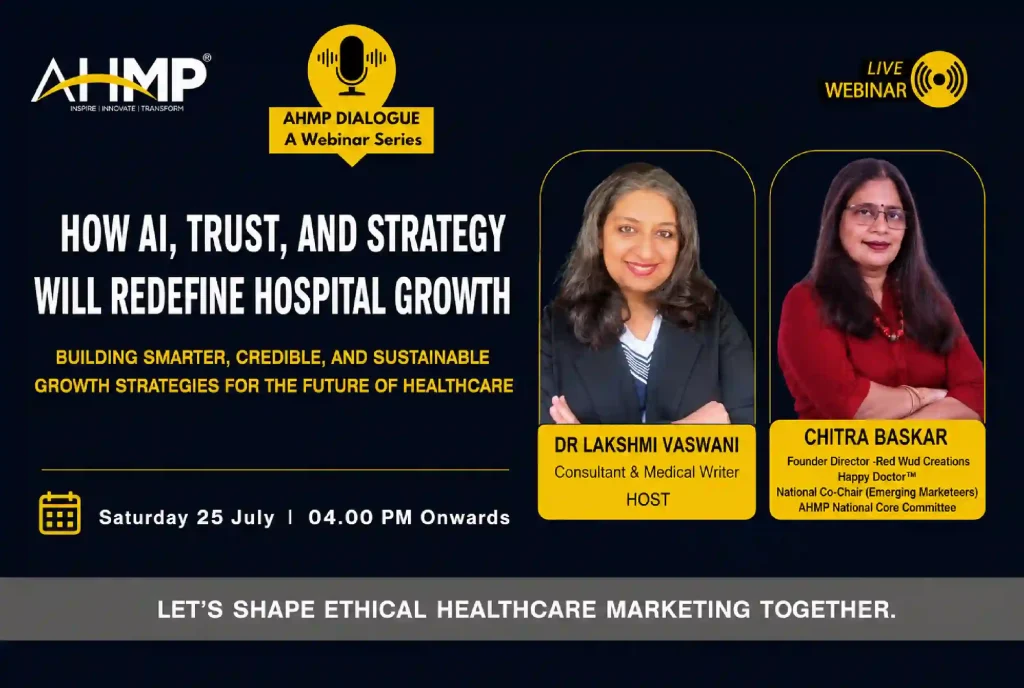
That conversation stayed with me, and it’s part of what I’ll be exploring at an upcoming session in the AHMP Dialogue Webinar Series, titled “How AI, Trust, and Strategy Will Redefine Hospital Growth.” The session will be hosted by Dr. Lakshmi Vaswani, Consultant & Medical Writer, on Saturday, 25th July, at 4:00 PM.
Beyond preparing for this conversation, it’s a question I find myself returning to often in my work at Red Wud Creations: what does hospital growth actually require in an era where AI is everywhere, but trust is still earned the old-fashioned way?
AI Is Moving Faster Than Trust Can Follow
Healthcare AI has moved from pilot programs to daily use in a relatively short span. Predictive analytics now inform triage decisions. Diagnostic tools flag anomalies faster than a radiologist scanning manually. Chatbots handle appointment scheduling and preliminary symptom checks. From a pure capability standpoint, this is progress that would have seemed distant even a few years ago.
But capability and acceptance are different things. Patients don’t evaluate AI the way engineers do. They evaluate it through a much simpler lens: do I trust the outcome, and do I understand why I’m being asked to trust it? A hospital can implement the most sophisticated AI system available and still watch adoption stall if patients feel like decisions are happening to them rather than with them.
This is the gap I keep coming back to — not a technology gap, but a communication gap. And it’s precisely the kind of gap that healthcare marketing, done well, is positioned to close.
Why Strategy Is the Missing Middle Ground
If AI is the tool and trust is the goal, strategy is what connects them. Without it, hospitals tend to adopt technology in isolated bursts — a new AI system here, a digital patient portal there — without a coherent plan for how these pieces fit into the patient’s overall experience or how they’re communicated.
A strategic approach asks different questions before implementation: How will this be explained to patients? Who is responsible for that explanation? What happens when the AI gets something wrong, and how is that handled transparently? These aren’t marketing questions in the traditional sense. They’re trust questions, and increasingly, healthcare marketing teams are the ones best equipped to answer them, because this is the work marketing does by nature — translating complexity into something people can understand and act on with confidence.
What Trust Actually Looks Like in a Hospital Setting
Trust in healthcare isn’t abstract. It shows up in specific, observable ways: a patient who understands why an AI tool flagged something in their scan. A family that isn’t confused by automated communication after a procedure. A hospital that acknowledges the limits of a technology rather than overselling it.
In my experience, hospitals that build trust well tend to share a common trait — they treat explanation as part of the clinical and marketing process, not an afterthought bolted on once the technology is already in use. This requires marketing and communication teams to be involved early, not brought in after the fact to “announce” a new system.
The Collaboration Healthcare Growth Actually Requires
None of this works if it sits with one department alone. Clinicians understand the medical reasoning behind AI tools. Administrators understand operational constraints and patient volume. Marketers understand how to communicate complex ideas clearly and empathetically. Technology teams understand the tool’s actual capabilities and limitations.
Hospital growth strategies that succeed tend to involve all four groups from the early stages, not sequentially, but simultaneously. This is slower and occasionally more difficult than letting one department drive the process alone. It’s also, in my experience, the only version of AI adoption that holds up once patients start asking questions — and they always do.
Why Ethical Communication Isn't Optional
There’s a temptation in any competitive industry to market technology in the most impressive terms possible. Healthcare cannot afford that temptation, because the claims involved touch people’s decisions about their own care.
Ethical healthcare communication means being precise about what an AI tool does and doesn’t do. It means not implying certainty where there is probability, and not using technical sophistication as a substitute for clear explanation. This isn’t just good practice — it’s the foundation on which long-term patient trust, and by extension long-term hospital growth, is actually built.
Why I'm Looking Forward to This Conversation
None of the perspectives I’ve shared here came from working in isolation. They’ve come from conversations — with hospital administrators, doctors, fellow marketers, and technology teams navigating the same questions from different angles. That’s exactly the kind of exchange I’m expecting at this AHMP Dialogue session.
I don’t think sessions like this work best when someone arrives with definitive answers. They work when a room full of people, each holding a different piece of the puzzle, compare notes and leave with a slightly more complete picture than they started with. That’s what I’m hoping for on 25th July, and it’s why I’d genuinely like as many perspectives in that room as possible — hospital leaders, doctors, marketers, and technology professionals alike.
Join the Conversation
If any of this resonates with the work you do — whether you’re running a hospital, leading a marketing team, practicing medicine, or building healthcare technology — I’d love for you to join us.
Session: How AI, Trust, and Strategy Will Redefine Hospital Growth Series: AHMP Dialogue – A Webinar Series Date: Saturday, 25th July Time: 4:00 PM onwards Host: Dr. Lakshmi Vaswani, Consultant & Medical Writer Speaker: Chitra Baskar, Founder Director, Red Wud Creations
This is a live, interactive session, and the conversation will be shaped as much by the questions in the room as by anything said from the front of it. If you’ve faced this tension between adopting new technology and maintaining patient trust, I’d particularly love to hear your experience.
Key Takeaways to Expect from the Session
- Why AI adoption in healthcare is accelerating faster than patient trust in these technologies
- How strategy connects AI capability to patient trust
- What ethical, transparent AI communication looks like in practice
- Why collaboration between clinicians, administrators, marketers, and technologists is essential for sustainable hospital growth
- How platforms like AHMP Dialogue are shaping this conversation across the healthcare industry
Closing Thought
The conversation I keep returning to isn’t really about AI. It’s about what happens after AI is introduced — whether hospitals invest as much in helping patients understand and trust these tools as they invest in the tools themselves. I don’t think there’s a shortcut here, and I’m looking forward to unpacking this further, together, on 25th July.
Register to attend, and bring your questions along.
About Chitra Baskar
Chitra Baskar is the Founder Director of Red Wud Creations, a healthcare branding and marketing practice, and the founder of Happy Doctor™. She currently serves as National Co-Chair, Emerging Marketeers, with the AHMP National Core Committee (2026–2028). Her work focuses on helping hospitals and healthcare practitioners communicate clearly, ethically, and effectively with the patients they serve, particularly as healthcare adopts new technologies such as AI.