Need help now? Call for a same-day consultation



Google Business Profile for Hospitals: How to Rank #1 on Google Maps and Get More Patient Calls
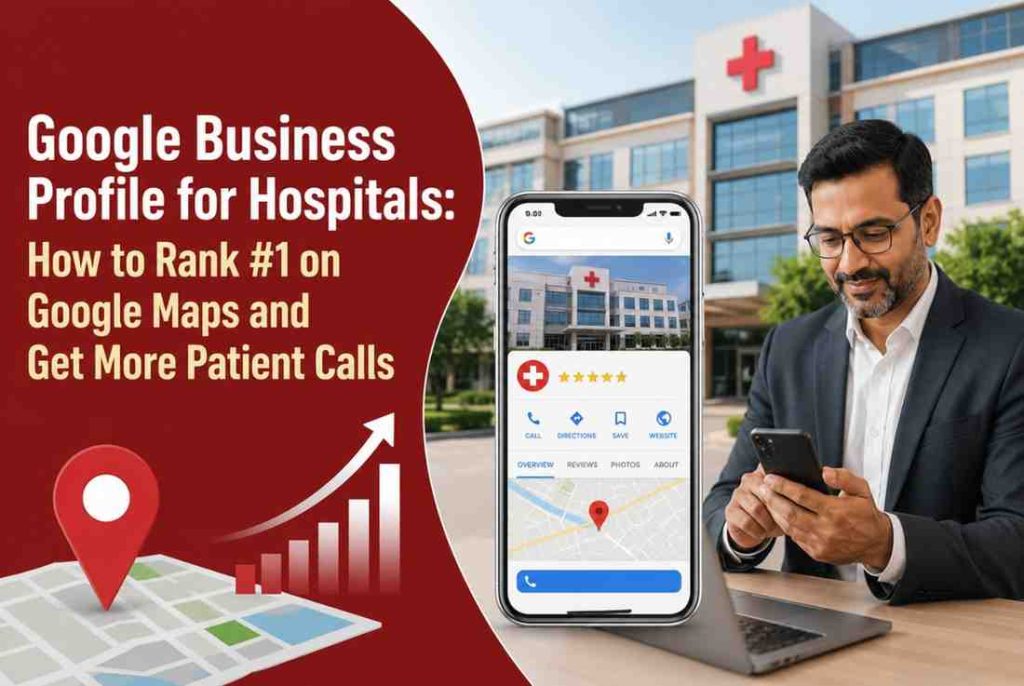
I once sat across from a hospital administrator in Chennai who was convinced his Google Ads budget was the problem. Three lakhs a month, he said, and patients still weren’t calling. I asked him one question before we even opened the ad account: “When did you last check your Google Business Profile?” He didn’t know what that was. His front office team had claimed it two years earlier and never touched it since. Wrong phone number. Photos from a hospital that had since renovated its entire lobby. Zero replies to reviews, including three one-star complaints about waiting times.
That hospital was spending money to drive traffic to a digital front door that looked abandoned. This is, without exception, the single most common and most fixable problem I see when I walk into a hospital’s marketing setup. A properly optimised Google Business Profile for hospitals in India is not a technical checkbox. It is often the first, and sometimes only, impression a patient forms of your facility before they decide whether to call.
The Real Problem: Everyone Optimises the Website, Nobody Optimises the Front Door
Here is what the industry keeps getting backwards. Hospital marketing teams pour budget and attention into the website — SEO agencies, content calendars, backlinks — while the Google Business Profile sits neglected in the background, managed by whoever happened to have Gmail access when the listing was first claimed.
But think about actual patient behaviour in India. A patient in Coimbatore searching for “orthopaedic hospital near me” at 11 PM with a swollen ankle is not browsing your website’s About page. They are looking at the Google Maps pack — three listings, star ratings, distance, and whether you’re open now. They decide in under fifteen seconds whether to call, and that decision is made almost entirely on what your Business Profile shows them, not your website.
I want to challenge something the SEO agencies rarely say out loud: a hospital with a mediocre website and an excellent, active Google Business Profile will out-perform a hospital with a beautiful website and a neglected profile, every single time, for local patient acquisition. This isn’t opinion. I have watched it happen across dozens of hospitals, from ten-bed nursing homes in semi-urban Tamil Nadu to large multi-specialty facilities in Chennai. The website builds long-term trust and brand. The Business Profile drives the phone to ring today. Most hospitals have this priority completely inverted, and it costs them real patients every week.
The Framework: What Actually Moves a Hospital to the Top of Google Maps
Ranking on Google Maps for healthcare terms comes down to three factors Google itself has confirmed for years — relevance, distance, and prominence — but almost nobody in Indian healthcare marketing explains what “prominence” actually means for a hospital specifically. Let me break it down properly, because this is where the competitor content out there stays frustratingly generic.
Step 1: Category and NAP accuracy, done at the department level. Most hospitals set one broad category — “Hospital” — and stop there. If you run a multi-specialty facility, you need department-specific attributes, correct sub-categories where Google allows them, and absolute consistency of your Name, Address, and Phone number across every directory, from Practo and Justdial to your own website footer. Inconsistent NAP data is one of the quietest rank-killers I encounter, and it usually traces back to different departments creating separate, uncoordinated listings for the same facility.
Step 2: Review velocity and review response, not just review count. A hospital with 40 reviews collected steadily over a year will consistently outperform one with 200 reviews all collected in a single burst three years ago. Google reads velocity as a signal of an active, real business. Equally important — and almost universally ignored — is responding to every review, especially the negative ones. A calm, professional response to a one-star review about wait times does more for prospective patient trust than ten generic five-star reviews with no replies. I have seen hospitals get defensive or ignore criticism entirely in this space. Both are mistakes. NMC guidelines and Indian advertising standards require restraint here too — no soliciting fake reviews, no promising outcomes in your responses, no comparative claims against named competitors.
Step 3: Photo and Q&A management as an ongoing job, not a one-time upload. Photos should be updated quarterly at minimum — reception area, OT standards where permissible, doctor profiles, parking and entrance visuals for first-time visitors. The Q&A section on your profile is public and editable by anyone, which means competitors or confused patients can post incorrect information that sits there unanswered for months. I make it standard practice for every hospital I work with to seed their own accurate Q&A entries proactively.
Step 4: Posts and updates that mirror real search behaviour. Google Business Profile allows weekly posts — health camps, new doctor onboarding, OPD timing changes, festival holiday hours. Hospitals that post consistently see measurably better visibility in the local pack than those that set up their profile and never return to it.
Here is a quick framework I use with clients to diagnose where their profile actually stands:
Profile Health Signal | Weak Hospital Profile | Strong Hospital Profile |
Category setup | Single generic category | Primary plus relevant sub-categories, department attributes filled |
Reviews | Burst-collected, unanswered | Steady monthly growth, every review answered within 48 hours |
Photos | Uploaded once at setup | Refreshed quarterly, department-wise galleries |
Posts | None or dormant | Weekly updates tied to real hospital activity |
NAP consistency | Conflicting across directories | Identical across Google, Practo, Justdial, website |
Q&A section | Empty or outdated | Proactively seeded with accurate answers |
The competitor content ranking for this keyword right now largely stops at “claim your listing and add photos.” It rarely addresses the department-level category problem multi-specialty hospitals face, almost never discusses review velocity as distinct from review count, and never touches the compliance angle around NMC guidelines in review responses. That gap is exactly where hospitals lose visibility without understanding why.
What This Changes
Get this right and the shift is measurable within 60 to 90 days, not months of guesswork. I have seen hospitals move from page two of the Maps pack to one of the top three local results simply by fixing category structure, clearing review response backlogs, and posting weekly for eight consecutive weeks. Short-term, this means more direct phone calls from patients who never touch your website at all. Long-term, it compounds — stronger local prominence supports every other digital investment you make, from paid ads to organic SEO, because Google is already reading your business as active, responsive, and legitimate. Patient footfall increases follow. So does the quality of patient, since someone finding you through an accurate, well-reviewed profile arrives with more trust than one clicking a cold ad.
How Chitra Works on This
When I audit a hospital’s Google Business Profile, I don’t start with the profile itself. I start with who owns it internally — because in nine out of ten engagements, the real problem isn’t strategy, it’s ownership. Nobody on staff has been assigned this as an actual responsibility with weekly time allocated to it. That’s the first thing that has to change before any tactic matters.
What makes my approach different from a standard digital agency is that I look at the Business Profile as one piece of the hospital’s entire patient acquisition system — connected to front office training, review response protocol, and how your reception team actually talks to patients who mention they found you on Google. An agency will hand you a checklist. I sit with your team and build the operating rhythm that keeps the profile alive long after I’ve left the room.
If you want to see exactly where your hospital’s profile stands, I’ve built a short self-assessment covering the areas outlined above — it takes about ten minutes and tells you precisely which of these levers is costing you the most visibility right now. You can request it directly through my Patient Acquisition Strategies page.
Closing and Call to Action
Your website tells patients who you are. Your Google Business Profile decides whether they ever get far enough to find out. If your hospital isn’t showing up where it should on Google Maps, the fix is rarely more advertising spend — it’s almost always something operational that’s been left unattended for far too long.
If you’re ready to find out exactly what’s holding your hospital back on Google Maps, book a strategy conversation with me directly. We’ll look at your actual profile, not a generic template, and figure out what’s realistic for your facility in the next 90 days.
Frequently Asked Questions
Why is my hospital not showing on Google Maps even after claiming the listing?
Claiming a listing is step one, not the finish line. Most hospitals lose visibility due to inconsistent NAP details across directories, a single generic category instead of specific sub-categories, stalled review activity, or a profile that hasn’t been posted to in months. Google reads inactivity as a weak signal of business legitimacy.
How often should a hospital post updates on its Google Business Profile?
Weekly is the standard I recommend to every hospital I work with. Posts about health camps, doctor availability, OPD timing changes, or seasonal advisories keep your profile active in Google’s eyes and give prospective patients a reason to trust that the information they’re seeing is current.
Do patient reviews actually affect hospital ranking on Google Maps?
Yes, significantly. Google weighs review velocity — steady, ongoing reviews — more heavily than a large historical count. Responding to every review, especially negative ones, professionally and within NMC advertising guidelines, also strengthens both ranking signals and patient trust.
Should a multi-specialty hospital have one Google Business Profile or separate listings per department?
One verified profile per physical location, with department-specific categories and attributes added within it. Separate listings for departments at the same address create duplicate-listing conflicts that confuse Google and dilute your ranking rather than strengthening it.
Can a small clinic in a semi-urban area compete with larger hospitals on Google Maps?
Absolutely, and often more easily than in dense urban markets. Local search favours proximity and active profile management. A well-maintained profile with consistent reviews and accurate details frequently outranks a larger, better-known facility with a neglected listing, especially outside metro-density search areas.