


Healthcare Marketing Leadership and AHMP CON2026: My Thoughts

Healthcare Marketing Leadership and AHMP CON2026: My Thoughts Healthcare marketing has changed a great deal since I first started working in this space. What used to be signage, brochures, and the occasional newspaper ad has now become something far more layered — a discipline that sits at the intersection of patient trust, clinical credibility, and digital communication. As I prepare to attend AHMP CON2026 – Healthcare Marketing Summit, Chennai Edition, in my capacity as National Co-Chair, Emerging Marketeers, AHMP National Core Committee (2026–2028), I find myself reflecting on a question that has stayed with me throughout my career: how does healthcare communicate honestly, effectively, and meaningfully with the people it serves? A Career Rooted in Healthcare Communication Through Red Wud Creations, my focus has always been on helping healthcare providers communicate clearly with their patients and communities. Healthcare branding carries a different weight than branding in most other industries. A hospital’s messaging touches decisions about health, trust, and sometimes urgency — it isn’t just about visibility, it’s about responsibility. Over the years, working closely with doctors, hospitals, and healthcare organizations has shaped the way I think about this work. I don’t see communication as a purely commercial exercise. I see it as something that carries real consequence for the people on the receiving end of it. This thinking eventually led me to start Happy Doctor™ — an initiative built around helping doctors and healthcare practices present themselves to patients in a way that stays true to clinical integrity, without stretching into marketing appeal for its own sake. Understanding My Role as National Co-Chair, Emerging Marketeers Being appointed National Co-Chair, Emerging Marketeers, with the AHMP National Core Committee (2026–2028) is a role I take seriously, and honestly, it isn’t about individual recognition. It’s about coordination — connecting marketers, hospital administrators, and healthcare communicators who are all navigating fairly similar challenges, often without any shared playbook to lean on. Emerging marketers in healthcare face a very specific tension. There’s a real need to build visibility for a practice or hospital, but that has to happen within the ethical boundaries healthcare demands. Part of what this committee tries to do is create space for these conversations to happen constructively, rather than leaving individual marketers to figure it out alone. What AHMP CON2026 Means to Me AHMP CON2026 is scheduled for 6th September 2026 at Sri Ramachandra Medical College & Research Institute, Chennai, and it brings together healthcare marketers, hospital leaders, and industry professionals for a day centered on shared learning. In my experience, events like this matter less for what gets announced on stage and more for the conversations that happen in between — comparing notes with a hospital administrator from a different city, or hearing how another clinic owner approached a communication challenge I’ve faced myself. For me, attending AHMP CON2026 is a continuation of something I’ve tried to stay close to throughout my career: these grounded, practical exchanges, rather than treating industry events as one-off appearances on a calendar. Why I Believe Collaboration Is the Foundation of Healthcare Marketing If there’s one thing I keep coming back to, it’s that healthcare marketing works best as a collaborative discipline. Hospitals, doctors, marketers, and technology providers each hold a piece of the puzzle when it comes to communicating healthcare services responsibly. No single agency or professional has a complete view of patient behavior, clinical nuance, and digital trends all at once — I certainly don’t claim to. That’s part of why platforms like AHMP matter to me. They create a shared space where healthcare marketing professionals can compare approaches and, where it makes sense, align on practices that ultimately serve patients better. On Ethics in Healthcare Communication Healthcare marketing carries obligations that other sectors simply don’t have to think about. What we say in this space can influence decisions about someone’s care, which is why accuracy and restraint matter to me — they aren’t optional extras. I’ve tried to keep this at the center of my own work: healthcare communication should inform and reassure, not exaggerate or mislead. This is a value I see echoed in the broader mission of committees like AHMP’s, which are built around encouraging responsible marketing practices for hospitals, clinics, and healthcare brands operating in an increasingly competitive digital environment. Looking Ahead As healthcare organizations continue adapting to digital-first patient journeys, I believe the need for thoughtful, ethical marketing guidance is only going to grow. My continued involvement with AHMP, alongside my ongoing work through Red Wud Creations, comes from a genuine, long-term interest in strengthening how India’s healthcare sector communicates — one conversation, one committee meeting, and one summit at a time. In Closing For me, attending AHMP CON2026 isn’t a standalone milestone — it’s part of an ongoing commitment to India’s healthcare marketing community. Through my work at Red Wud Creations and my role with the AHMP National Core Committee, I hope to keep advocating for a version of healthcare marketing that prioritizes clarity, trust, and collaboration. These are values I believe matter as much to hospitals and clinics as they do to the patients we’re all ultimately here to serve.
Hospital Marketing Strategy in India: The Complete Framework Hospital CEOs Need in 2026
Hospital Marketing Strategy in India: The Complete Framework Hospital CEOs Need in 2026 I started my career at Apollo Hospitals in 1993. Back then, the idea that a hospital needed to think about marketing at all was considered slightly undignified in some circles. Thirty years later, I watch hospital CEOs commission a “marketing strategy” that is really just a digital media plan wearing a bigger title — a bundle of SEO, Google Ads, and Instagram reels with no underlying business logic connecting it to occupancy targets or specialty growth. That is not a strategy. It is a shopping list. A real hospital marketing strategy India 2026 has to start somewhere other than the channel mix. It starts with what the hospital is actually trying to become over the next three years, and works backward from there. I have built these frameworks with hospital boards across Chennai, Coimbatore, and smaller markets across Tamil Nadu, and the hospitals that get real, durable growth are never the ones who started with “which platform should we advertise on.” This article gives you the framework I actually use — not a digital marketing checklist rebranded as strategy. The Real Problem: Strategy Has Been Replaced by Tactics Search “hospital marketing strategy” and most of what ranks is a list of channels — SEO, Google Business Profile, Meta Ads, WhatsApp, reviews. All useful. None of it is strategy. Strategy is the layer above that decides which specialties you’re growing, which patient segments you’re targeting, and what your hospital stands for that a competitor three kilometers away doesn’t. Here’s what I disagree with, based on three decades inside this: hospital boards keep treating marketing as a spend line to optimize rather than a growth lever tied to occupancy and specialty mix. I’ve sat in reviews where a hospital was running strong digital campaigns for general OPD while its cardiac cath lab — the highest-margin, highest-differentiation asset in the building — got almost no dedicated marketing attention at all. Nobody had asked the strategic question first: which service lines actually need demand generation, and which ones are already full and just need better patient experience to retain volume? The other assumption I push back on: that a bigger ad budget fixes a trust problem. It doesn’t. Indian patients — especially outside the top metros — are researching heavily before they choose a hospital, cross-checking Google reviews, WhatsApp referrals, and what their own doctor or a trusted relative says. A hospital with a shaky reputation and a large ad budget just buys itself more visibility for the wrong reasons. The Framework: Five Layers of a Real Hospital Marketing Strategy I build every hospital marketing strategy across five layers, in sequence. Skipping to layer four without the first three is exactly how boards end up with expensive tactics and flat growth. Layer 1 — Strategic Positioning. Before any campaign, define what the hospital is actually known for, or wants to be known for, in its market. Is it the multi-specialty option for a semi-urban catchment area, or the specialist destination for a specific service line — cardiac, oncology, fertility — that draws patients from beyond the immediate radius? These require entirely different marketing strategies. I’ve seen hospitals try to be “everything to everyone” in their messaging and end up memorable for nothing. Layer 2 — Service Line Prioritization. Not every department deserves equal marketing investment. I map service lines against two variables: current occupancy/utilization and strategic margin importance. A service line running at 85% capacity doesn’t need demand-generation marketing; it needs retention and reputation management. A high-margin service line running under capacity is where marketing spend should concentrate. Most hospital marketing plans I review skip this mapping entirely and spread budget evenly across departments, which wastes money on service lines that were never the bottleneck. Layer 3 — Referral and Trust Infrastructure. This is the layer competitor content underweights most. In India, a huge share of hospital patient volume — particularly outside metro markets — still comes through doctor referrals, GP networks, and word-of-mouth, not digital discovery. A real strategy formalizes this: mapping local GPs, diagnostic labs, and specialists within the catchment area, running periodic CME sessions, and tracking referral sources so the hospital actually knows where its patients come from. Pair this with disciplined Google review management — patients increasingly verify a referral or an ad through reviews before booking, so trust infrastructure and referral infrastructure have to work together, not separately. Layer 4 — Digital Execution, Matched to Layer 1 and 2. Only now does the channel conversation happen — and it should already be informed by positioning and service-line priority. Component Purpose Where hospitals get it wrong Local SEO / Google Business Profile Capture “near me” and locality-specific search Left unclaimed or inconsistently updated across departments Specialty landing pages Rank for and convert high-value service-line searches Built once and never updated with outcomes data or FAQs Google reviews system Trust signal that verifies referrals and ads Reactive instead of systematic; ignored after negative reviews Paid search/social Fill demand gaps in under-capacity, high-margin service lines Applied uniformly across departments regardless of actual need Content/patient education AI Overview visibility, YMYL trust signals Written once for SEO, never reviewed by clinical staff for accuracy Layer 5 — Measurement Tied to Business Outcomes. Track source-wise patient mix — referral, local SEO, paid, walk-in — monthly, and connect it to occupancy and OPD-to-IPD conversion, not just leads or clicks. A hospital celebrating a low cost-per-lead while its actual bed occupancy hasn’t moved is measuring the wrong thing. The metric that matters to a board is patients converted and retained per service line, against the investment made in that specific layer. The mistake I see most often executing this framework: hospitals jump straight to layer four because it’s the most visible and vendor-friendly layer to execute, and they skip layers one through three because those require internal strategic decisions, not just budget approval. What This Changes Done correctly, this shift is visible within
What Is a Doctorpreneur? The Complete Guide to Running a Profitable Medical Practice in India
What Is a Doctorpreneur? The Complete Guide to Running a Profitable Medical Practice in India I started my career at Apollo Hospitals in 1993. Back then, the idea that a hospital needed to think about marketing at all was considered slightly undignified in some circles. Thirty years later, I sit across the table from young doctors who’ve done the opposite mistake — they’ve built a beautiful Instagram page and a slick logo before they’ve figured out how many patients they need per day just to cover rent. Both extremes come from the same gap: nobody taught them how to run the business side of medicine. That gap is exactly what the word doctorpreneur India is trying to describe. A doctorpreneur is a doctor who runs their practice, clinic, or venture as a business — with the systems, financial discipline, and strategic thinking that requires — without losing the clinical judgment that got them there in the first place. It’s a good word. I just think most people using it right now are selling the dream part and skipping the operating manual. The Real Problem With How “Doctorpreneur” Gets Taught Walk into any doctorpreneur workshop in India today and you’ll hear a lot about mindset — think like a CEO, take risks, build your brand. I don’t disagree with any of it. But I’ve mentored enough doctors building clinics from scratch to know that mindset without mechanics gets you a doctor who’s motivated and broke within eighteen months. Here’s the assumption I push back on hardest: that clinical excellence plus enthusiasm equals a sustainable practice. It doesn’t. A doctor in Madurai who is brilliant with patients can still fail as a business owner if she doesn’t understand her breakeven patient volume, her staff cost ratio, or why her clinic’s cash flow disappears every March. Medical training in India teaches diagnosis and treatment. It does not teach P&L statements, hiring, or how to say no to a landlord’s rent hike. That’s not a mindset problem — it’s a skills gap, and pretending otherwise sets doctors up to learn expensive lessons the hard way. The other gap I see in most doctorpreneur content: it talks about “starting a business” as if opening the clinic is the finish line. In my experience, the first eighteen months after opening are where most doctorpreneurs actually fail — not the planning stage, not the launch, but the unglamorous middle where systems either hold or collapse. The Framework: Four Things Every Doctorpreneur in India Needs to Get Right I break this down into four pillars. Most doctorpreneur programs cover pillar one and stop. That’s the shallow end of the pool. Pillar 1 — Financial Literacy, Not Financial Optimism. Before anything else, a doctor needs to know their numbers: fixed costs (rent, staff, equipment EMI), variable costs per patient, and the breakeven patient count per day. I’ve sat with doctors three months into a new clinic who genuinely didn’t know if they were profitable — they were going by “gut feel” and bank balance. That’s not a business, that’s a hope. A basic monthly P&L, reviewed personally, not outsourced entirely to an accountant who never explains it back to you, is where every doctorpreneur journey should start. Pillar 2 — Systems Before Scale. This is the single most under-discussed piece of doctorpreneur advice in India. Before you think about a second location or a bigger team, you need documented systems — patient intake, follow-up protocols, staff SOPs, appointment scheduling. Doctor-led hospitals and clinics that scale without systems don’t get bigger versions of themselves; they get chaotic versions of themselves. I’ve watched a single-doctor clinic with excellent word-of-mouth try to open a second branch with no written SOPs, and the second branch actively damaged the reputation the first one had built. Pillar 3 — Team and Delegation. Most doctors are trained to be the smartest person handling the most critical decision in the room. That instinct, if it doesn’t evolve, kills delegation. A doctorpreneur has to learn to hire people — an office manager, a patient coordinator — who are better than them at things that aren’t clinical. I tell doctors this directly: if you are still personally handling appointment scheduling and billing follow-ups two years into your practice, you don’t have a business, you have a very expensive job. Pillar 4 — Compliant, Trust-First Growth. This is where marketing enters, but not the way most content frames it. Growth for a doctorpreneur in India has to work within NMC ethics guidelines — no outcome guarantees, no unauthorized testimonials, no comparative claims. What works instead is patient education content, strong Google review management, and referral systems built on actual patient experience. Doctorpreneurs who try to grow through aggressive self-promotion on social media are the ones most likely to run into ethics complaints; doctorpreneurs who grow through trust and consistency are the ones still practicing five years later. Stage Doctor mindset Doctorpreneur mindset Pricing “What feels fair” Priced against actual cost-per-patient and breakeven math Growth More patients, however they come Right patients, through compliant, trust-building channels Team “I’ll just do it myself, it’s faster” Delegated with documented SOPs Scaling Open a second branch when busy Open a second branch when systems are proven repeatable The doctors I’ve seen build genuinely resilient practices — including the newer wave of doctor-led hospitals emerging in Tier 2 towns across Tamil Nadu and beyond — are the ones who treated pillar 1 and 2 as seriously as their clinical training, not as an afterthought they’d “figure out later.” What This Changes Get these four pillars right and the shift isn’t dramatic overnight — it’s structural. Short-term, you stop feeling like you’re guessing every month; you know your numbers and can make decisions instead of reacting to them. Medium-term, your team runs the practice without you personally holding every thread, which means you can actually take a holiday without the clinic falling apart. Long-term, this is what makes a practice sellable, scalable, or simply sustainable
Healthcare Digital Marketing for Hospitals: The 2026 Strategy That Actually Works in India
Healthcare Digital Marketing for Hospitals: The 2026 Strategy That Actually Works in India I started my career at Apollo Hospitals in 1993. Back then, the idea that a hospital needed to think about marketing at all was considered slightly undignified in some circles. Thirty years later, I watch hospitals burn budgets on digital campaigns and still wonder why patients are not walking through the door. The answer is almost never the campaign. It is almost always something that was broken long before the agency was hired. That is where most conversations about healthcare digital marketing India 2026 go wrong. Hospital boards ask for a bigger ad spend when the real problem is sitting three floors down, in the appointment desk, the discharge process, or the doctor who never returns a WhatsApp query within 24 hours. I have sat in enough review meetings to know the pattern by heart: impressive reach numbers on a dashboard, and an OPD that is still half-empty on a Tuesday. This article is not another checklist of SEO tactics. It is what I have actually seen move the needle for hospitals and clinics across Chennai, Coimbatore, Bengaluru, and smaller South Indian towns — and what I have watched quietly fail, even with a six-figure monthly budget behind it. The Real Problem Nobody Names Most agencies selling hospital digital marketing strategy India packages treat healthcare like any other lead-generation business. Run some Meta ads, optimize a landing page, track cost-per-lead, report the number, repeat. That model works for a furniture brand. It does not work for a hospital, because a lead in healthcare is a frightened person, often accompanying a sick parent or child, deciding who to trust with something that matters more than almost anything else in their life. Here is the assumption I disagree with most: that patient acquisition is a top-of-funnel problem. In my experience, for Indian hospitals, it is a trust and access problem disguised as a marketing problem. A patient in Coimbatore searching for a cardiologist is not comparing ad copy. She is comparing Google reviews, asking her building WhatsApp group, and calling a cousin who worked in healthcare once. Digital marketing that ignores this reality — and just chases clicks — is why so many hospitals see traffic go up and conversions stay flat. There’s also a regulatory reality that most generic marketing content glosses over. Indian healthcare advertising sits under NMC ethics guidelines, and outcome claims, guaranteed cure promises, and unverified testimonials are not just bad practice — they are the kind of thing that gets a hospital’s compliance team, and sometimes its board, into real trouble. Any strategy built without this constraint baked in from day one is not a strategy. It is a liability waiting to surface. The Framework: What Actually Works in Indian Healthcare Marketing in 2026 I build every engagement around four layers, in this order. Skip a layer and the ones above it doesn’t hold. Layer 1 — Operational Readiness. Before a single rupee goes into ads, I audit what happens after someone clicks. Does the front desk answer the phone in under three rings? Is there a WhatsApp Business number that’s actually monitored? Can a patient book an appointment without calling during business hours? I have walked into hospitals with beautiful websites and a call center that takes four rings to answer and drops half its calls after 6 pm. No campaign fixes that. This is non-negotiable groundwork for any digital marketing for clinics India initiative, and it’s the step every agency-led plan I’ve reviewed skips entirely. Layer 2 — Trust Infrastructure. This is Google reviews management, doctor profile optimization on Google Business, and consistent, factual content that educates rather than sells. Under NMC rules, you cannot advertise a “100% success rate” or use before-and-after imagery to solicit patients — but you can publish genuinely useful patient education content, and that content compounds. A well-written explainer on “what to expect before a knee replacement” rank, builds trust, and stays compliant, all at once. Hospitals that treat content as an SEO checkbox instead of a trust-building tool are leaving the single highest-ROI channel untouched. Layer 3 — Channel Strategy, Matched to Intent. This is where most competitor guides stay shallow — they list channels without explaining when each one actually earns its budget. Channel Best for Where it fails Google Search Ads High-intent, urgent needs (emergency, specialist appointment) Expensive in metro cities; wasted on awareness-stage services Meta Ads Elective and wellness services patients haven’t actively searched for Poor for acute-care or emergency positioning Local SEO / Google Business Profile Neighborhood clinics, walk-in-driven specialties Slow to build; needs 3-6 months of consistent input WhatsApp / Direct Messaging Follow-up, appointment reminders, semi-urban patient bases with lower search behavior Not a discovery channel; only works once trust exists Educational Content / SEO Long-term authority, AI Overview visibility, referral-quality patients Takes longest to show revenue impact The mistake I see repeated across South Indian hospitals is picking one channel and expecting it to do the job of all four. A multi-specialty hospital in a semi-urban Tamil Nadu district needs a completely different channel mix than a boutique cosmetic clinic in central Chennai — patient search behavior, digital literacy, and urgency all differ sharply between urban and semi-urban India, and a copy-paste national strategy ignores that every time. Layer 4 — Measurement That Reflects Reality. Cost-per-lead is a vanity metric in healthcare if you’re not also tracking lead-to-consultation and consultation-to-treatment conversion. I have seen hospitals celebrate a low CPL while their actual patient conversion from that channel was near zero, because the leads were curiosity clicks, not real intent. The metric that matters is cost per booked, attended consultation — everything upstream of that is a proxy. What This Changes Get these four layers right and the shift is visible within a quarter — not in vanity traffic numbers, but in booked appointments, and in the front desk telling you patients are mentioning “I read your article on X”
The Real Cost of Not Having a Marketing Leader in Your Hospital — And What It Is Costing You Every Month
The Real Cost of Not Having a Marketing Leader in Your Hospital — And What It Is Costing You Every Month Opening There is a particular kind of hospital owner I have met many times over thirty years. They are not failing. Their hospital is functioning. Doctors are showing up, patients are coming in, bills are being paid. But growth has stalled somewhere between survival and scale, and nobody can quite explain why. I met one such owner in Chennai about three years ago. Eighty-bed hospital, eight years in operation, solid reputation in the locality. He was spending ₹1.2 lakh a month on a digital agency and another ₹40,000 on a PR firm. When I asked him who was responsible for the hospital’s marketing strategy, he said: “The agency handles all of that.” That answer told me everything. The hospital marketing leadership gap in India is not a funding problem. It is not a talent problem. It is an accountability problem. Nobody inside that hospital owned the growth outcome. The agency owned the campaign. The PR firm owned the press releases. And the hospital owner owned the confusion. That gap — invisible, unmeasured, and expensive — is what this article is about. The Real Problem Here is the assumption that is quietly destroying the growth of hundreds of Indian hospitals right now: that marketing is something you outsource, not something you lead. I understand why this assumption exists. Hospital administrators are trained to manage clinical operations, compliance, finance, and HR. Marketing feels like a separate domain — one that agencies and vendors are better equipped to handle. So the hospital writes a cheque, the vendor produces deliverables, and everyone agrees the marketing box is ticked. It is not ticked. It is delegated without accountability. An agency’s job is to execute what they are briefed to execute. They are not responsible for your occupancy rate. They are not responsible for whether your highest-margin procedures are being positioned correctly in your catchment area. They are not responsible for why your semi-private ward is consistently underutilized while your general ward is overflowing. Those are strategic questions. And without a marketing leader inside your organization — someone who owns those questions — they simply do not get answered. The bold truth is this: a hospital without marketing leadership is not doing marketing. It is doing marketing activity. And marketing activity without strategic direction is just spending. In Tamil Nadu alone, I have seen hospitals with genuinely superior clinical teams lose patients to less capable competitors simply because someone at the competitor was thinking about patient acquisition systematically and nobody at the first hospital was. That is not a marketing problem. That is a leadership problem. What the Hospital Marketing Leadership Gap Is Actually Costing You Let me make this concrete. Because the cost of this gap is not abstract — it shows up in specific, measurable places every single month. Leaked Inquiries You Are Not Measuring The average Indian hospital loses between 25% and 40% of inbound inquiries before they become appointments. Phone calls that go unanswered. WhatsApp messages that get a response 18 hours later. Website contact forms that land in an inbox nobody checks. Without a marketing leader, nobody is tracking this. Nobody is calculating that if your hospital receives 200 digital inquiries a month and converts 60, you are losing 140 potential patient relationships — and at an average OPD value of ₹800 to ₹1,200 and downstream procedure potential multiples higher, that leakage is not a rounding error. It is a revenue line. GP Referral Networks That Are Quietly Eroding In South India, GP referrals still drive 40% to 65% of hospital admissions depending on specialty and geography. This channel requires active, structured relationship management — not gifts, not commissions, but genuine clinical engagement and trust-building over time. Without someone owning this channel, it drifts. GPs who were once loyal referrers start sending patients elsewhere — not because they are unhappy, but because a competitor’s representative showed up and yours did not. I have seen hospitals lose 30% of their referral base over 18 months without ever noticing, because nobody was tracking referral source data month on month. Budget Wasted on the Wrong Channels Most hospitals in India are spending on digital advertising because everyone else is. But digital works very differently depending on whether your hospital is in Chennai’s Anna Nagar, a Tier 2 city in Andhra Pradesh, or a semi-urban town in Kerala. Patient search behavior, trust thresholds, and decision-making timelines vary significantly across these markets. Without a marketing leader who understands your specific geography, your agency will default to what worked for their last client. You will pay for reach in demographics that will never convert. You will run awareness campaigns when what you need is conversion campaigns. You will measure followers when you should be measuring cost per OPD registration. Positioning Drift This is the most expensive cost and the hardest to see. Over time, a hospital without marketing leadership loses clarity about what it stands for. Different doctors promote different specialties. The website says one thing. The social media says another. The front desk communicates something else entirely. Patients in India make hospital decisions based on trust and reputation — often more than clinical metrics. When a hospital’s positioning is inconsistent, trust erodes slowly and invisibly. By the time the owner notices the occupancy trend, the reputational damage has been compounding for years. What Changes When Marketing Leadership Is in Place When a hospital fills this leadership gap — whether through a full-time hire, a fractional CMO, or a structured consulting engagement — the shift is rapid and measurable. Within 60 days, inquiry tracking gets implemented and leakage gets addressed. The front desk starts converting calls instead of losing them. The GP referral program gets a quarterly calendar and someone responsible for running it. Ad spend gets audited and reallocated to channels that produce registrations, not just impressions. Within six months, the hospital has a
How a Fractional CMO Helped a 100-Bed Hospital Grow Patient Revenue by 40% Without a Full Marketing Team
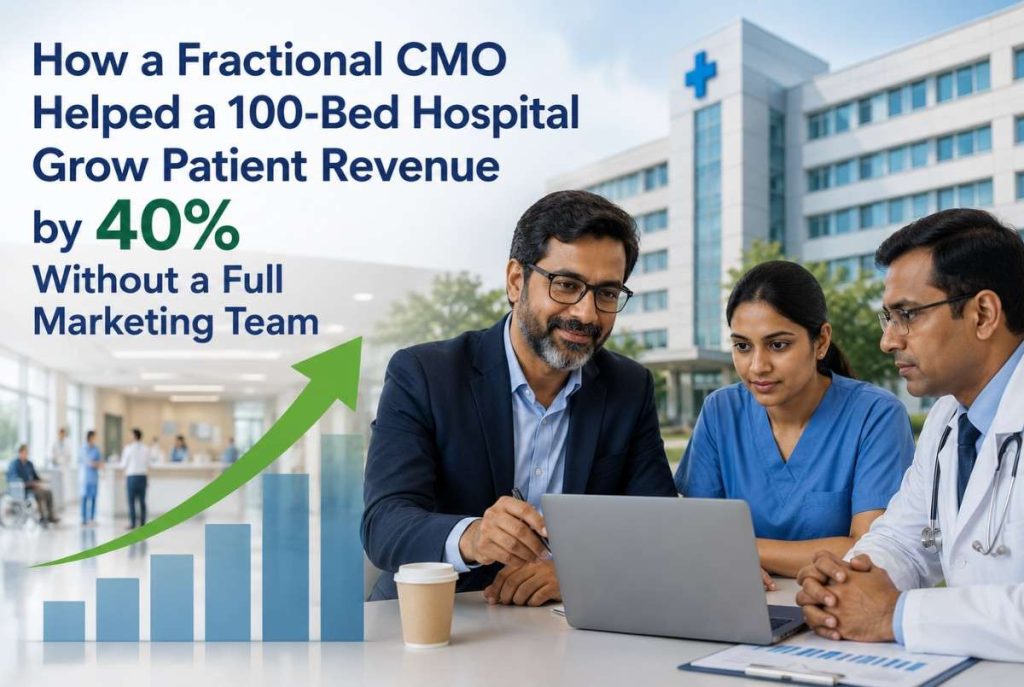
How a Fractional CMO Helped a 100-Bed Hospital Grow Patient Revenue by 40% Without a Full Marketing Team Opening A few years ago, a hospital administrator from a mid-sized town in Andhra Pradesh called me in a state of quiet desperation. His hospital had 100 beds, a genuinely strong surgical team, and a location that should have been an advantage. He had been running for four years. Occupancy was stuck at 42%. He had tried two agencies. He had a Facebook page with decent followers. He had even printed a glossy brochure. Nothing was moving. When I asked him what his patient acquisition strategy was, he described his marketing spend. Those are not the same thing. And that distinction — between spending money on marketing and having a strategy that drives fractional CMO hospital growth in India — is the entire difference between a hospital that survives and one that thrives. What followed over the next 12 months was not a marketing miracle. It was structured, unglamorous work. The kind that most agencies will not do because it does not fit into a monthly retainer model. By the end, his occupancy had crossed 72% and revenue had grown by over 40%. This is what actually happened — and what you can learn from it. The Real Problem The hospital industry in India has a dangerous blind spot. Most owners measure their marketing investment by what they spend, not by what it produces. So when growth stalls, the instinct is to spend more — more ads, more platforms, more vendors. I have watched this play out in Chennai, in Vijayawada, in Madurai, in Nashik. The pattern is almost identical every time. The hospital increases the digital budget. The agency delivers a report showing improved reach. OPD numbers stay flat. The owner concludes that marketing does not work in their market, or that patients in their area are not digitally active, or that competition is simply too intense. None of those conclusions are usually correct. The real issue is that marketing spend without marketing leadership produces noise, not growth. Someone needs to be responsible for the strategy — for deciding which patient segments to prioritize, which referral channels to invest in, how the hospital’s reputation is being shaped in the community, and whether any of the spend is connecting to actual admissions. Here is the assumption I want to challenge directly: a hospital does not need a bigger marketing budget. It needs someone accountable for marketing outcomes. For a 100-bed hospital in India, hiring a full-time CMO at ₹35–50 lakh per year is rarely viable and often unnecessary. What works is fractional marketing leadership — experienced, senior, and structured around results. How Fractional CMO Hospital Growth Actually Works: The 4-Phase Framework This is not a theoretical model. It is the sequence I used with that hospital in Andhra Pradesh, and variations of it across dozens of engagements in South India. Phase 1: The Honest Audit (Weeks 1 to 4) Before any strategy is built, I look at what is actually happening. Not what the hospital thinks is happening. What the data says. This means pulling 12 months of OPD registration data and mapping it by source — walk-in, referral, digital inquiry, repeat visit. It means interviewing the front desk staff, because they hear things no administrator ever does. It means reading every Google review written in the last year, including the ones the hospital has tried to suppress. It means sitting with the top three doctors and understanding how they think about their own patient base. In this particular case, the audit revealed three things the owner did not know. First, 60% of new patients were coming through GP referrals, but there was no structured program to nurture or expand that network. Second, the front desk was losing nearly one in three phone inquiries because calls were going unanswered during peak hours. Third, the hospital’s strongest clinical offering — a bariatric surgery program — had almost no visibility in the local market despite being genuinely differentiated. None of these problems would have been solved by more Instagram posts. Phase 2: Strategic Positioning (Weeks 4 to 8) Once the audit is complete, the work is to define what the hospital actually stands for in its market — clearly enough that a patient in a semi-urban area with multiple hospital options has a specific reason to choose it. For this hospital, we built the positioning around three things: the bariatric program, a genuine commitment to transparent pricing, and a strong network of trusted local GPs. Each of these was real. None of them were being communicated consistently or credibly. This is where most fractional CMO engagements deliver immediate value that no agency can replicate. An agency will position a hospital however the brief tells them to. A fractional CMO interrogates what is actually true and builds from there — because in Indian healthcare, patients are sophisticated enough to detect the gap between what a hospital claims and what it delivers. Phase 3: Channel and Referral Architecture (Weeks 8 to 16) With positioning defined, the next step is building the actual acquisition infrastructure. For this hospital, that meant three parallel workstreams. The GP referral program was structured as a quarterly engagement series — not gifts or commissions, which create compliance risk, but clinical education sessions that positioned the hospital’s specialists as genuine partners. Within six months, active referring GPs had grown from 18 to 47. The digital channel was rebuilt around search intent — patients in the catchment area searching for specific procedures, not generic hospital queries. Ad spend actually decreased by 30% while inquiry volume increased, because we stopped running awareness campaigns and started running conversion campaigns with proper tracking. The front desk issue was addressed with a simple operational fix: a dedicated inquiry management protocol with callback commitments and a WhatsApp intake process for patients who preferred not to call. Phase 4: Metrics and Accountability (Ongoing) The final piece — and the
What Is a Fractional CMO and Why Every Growing Hospital in India Needs One in 2026
What Is a Fractional CMO and Why Every Growing Hospital in India Needs One in 2026 Opening I have sat across the table from hospital owners in Chennai, Coimbatore, Madurai, and smaller towns across Tamil Nadu and Andhra Pradesh who all had the same story. They hired a digital marketing agency. They spent anywhere from ₹50,000 to ₹3 lakh a month. They got reports full of impressions and reach numbers. And they still had empty OPD slots on Tuesday afternoons. When I asked them who owned the marketing strategy inside the hospital, there was silence. Not because they did not understand the question. Because there was no answer. That gap — between spending on marketing and having someone who actually leads marketing — is where most hospitals quietly bleed growth. And it is exactly the gap that a fractional CMO for hospitals in India is designed to close. Not with a bigger budget. Not with another agency. With experienced, senior marketing leadership that your hospital can access without the cost or the risk of a full-time hire. This is what that looks like in practice. And more importantly, this is when it works and when it does not. The Real Problem Here is the assumption I want to challenge directly: most hospital administrators believe their marketing problem is execution. They think they need better ads, a more active Instagram page, or a sharper Google My Business listing. So they hire vendors to execute. The actual problem is almost always upstream. It is positioning. It is the absence of a coherent patient acquisition strategy. It is that the hospital has never clearly defined who it is trying to serve, what it is genuinely better at than the hospital three kilometres away, and why a patient in a semi-urban area with four hospital options should choose them specifically. No agency fixes that. An agency executes whatever brief you give them. If the brief is vague or wrong, the execution will be expensive and ineffective. This is the reality I have seen play out across hundreds of hospitals across South India. A 60-bed multi-specialty hospital in a Tier 2 city in Tamil Nadu does not have the same marketing challenges as a corporate chain in Chennai. The patient behavior is different. The trust signals are different. The referral dynamics with local GPs are completely different. The impact of a doctor’s personal reputation on footfall is far more pronounced than any digital campaign. What these hospitals need is someone who understands all of this and can build a strategy around it. A fractional chief marketing officer for healthcare in India does exactly that — without the hospital having to commit to a ₹30–50 lakh annual salary for a full-time CMO who may have never worked inside a hospital in their life. What a Fractional CMO Actually Does for a Hospital in India Let me be specific. Because the term gets used loosely and deserves a precise definition. A fractional CMO is a senior marketing strategist who works with your hospital on a part-time or project basis — typically 2 to 3 days per week or structured around defined deliverables. They operate at the leadership level, not the execution level. They set strategy, align your internal team and external vendors, track the right metrics, and make decisions that a junior marketing manager or an external agency simply cannot make. They are not a consultant who delivers a report and disappears. They are not an agency account manager. They are not a social media manager with a fancier title. If anyone is offering you fractional CMO services and their primary output is content calendars and ad creatives, you are paying CMO prices for coordinator work. Strategy Before Spend Before any budget is deployed, a fractional CMO conducts a market positioning audit. For Indian hospitals, this means understanding your catchment area demographics, your actual competitive differentiators, your current referral network health, and where your OPD funnel is genuinely leaking. I have done this audit for hospitals that were convinced their problem was low digital visibility. In several cases, the real issue was that their discharge process was so poor that no patient was referring anyone. No Instagram campaign fixes a broken discharge experience. Alignment Between Clinical and Marketing This is the piece that generic consultants always miss. In Indian hospitals, the relationship between the marketing function and the clinical team is often adversarial or simply non-existent. Doctors feel that marketing is beneath them. The marketing team does not understand clinical workflows. The result is campaigns that make promises the clinical team cannot consistently deliver. A fractional CMO who has lived inside healthcare knows how to build this alignment. They speak both languages. They can sit with your senior surgeons, understand what genuinely differentiates your orthopedics department, and translate that into a patient-facing narrative that respects NMC advertising guidelines while still being compelling. Vendor Accountability Most hospitals have no one internally who can hold a digital agency to a meaningful standard. The agency sends a monthly report. The hospital owner looks at the follower count. No one is tracking cost per OPD registration, referral conversion rate from GP outreach programs, or the percentage of high-value procedure inquiries that actually convert to admissions. A fractional CMO defines the right KPIs, builds the tracking systems, and holds vendors to outcomes that connect to revenue — not vanity metrics. Scalable Infrastructure The fractional model works particularly well for hospitals in the 50 to 200-bed range — the growth corridor where Indian healthcare is genuinely expanding right now. These hospitals are too large to operate without a marketing strategy and too small to justify a full CMO. A fractional engagement builds the systems, trains the internal team, and creates documented processes that the hospital owns permanently. Fractional CMO vs Full-Time CMO vs Agency: A Quick Comparison Factor | Full-Time CMO | Fractional CMO | Agency Only Annual Cost (India) | ₹30–50 lakh+ | ₹8–18 lakh | ₹6–36 lakh Strategic Leadership |
Why India’s Healthcare Excellence Needs Better Positioning
Why India’s Healthcare Excellence Needs Better Positioning At the 16th Edition of TANCARE 2025, I had the opportunity to speak about a subject that has shaped much of my work in healthcare branding and strategic positioning. My core message was simple: India does not lack capability. It lacks positioning. Over the years, I have heard remarkable statements about Indian healthcare: Indian doctors are among the best in the world. Clinical outcomes in many Indian hospitals rival global benchmarks. Chennai has emerged as one of the world’s most sought-after destinations for advanced healthcare and medical value travel. Yet despite these strengths, a fundamental question remains: Why isn’t India’s healthcare story more visible on the global stage? The challenge has never been the absence of excellence. The challenge has been the absence of strategic positioning. Excellence Alone Does Not Build Reputation Healthcare organizations often assume that quality speaks for itself. It doesn’t. Patients, investors, healthcare partners, policymakers, and international stakeholders make decisions based on perception, trust, visibility, and credibility long before they experience clinical outcomes firsthand. In today’s competitive healthcare landscape, excellence must be accompanied by a clear narrative. A hospital may have world-class outcomes. A healthcare ecosystem may have unmatched expertise. A region may be producing extraordinary medical achievements. But if those stories are not being communicated effectively, their impact remains limited. https://www.youtube.com/watch?v=trEPTy0T-cY Tamil Nadu: A Brand Waiting to Be Amplified Tamil Nadu has built one of the strongest healthcare ecosystems in India. Its strengths include: Clinical excellence across specialties Leadership in organ transplantation Advanced medical education International accreditations Ethical healthcare delivery Strong patient outcomes A thriving medical value travel ecosystem These are not merely healthcare achievements. They are powerful brand assets. The opportunity lies in transforming these assets into a compelling global healthcare narrative. The Future Belongs to Healthcare Brands That Tell Their Story Around the world, leading healthcare destinations invest heavily in branding, reputation management, thought leadership, and strategic communication. They understand that visibility creates trust. Trust creates preference. And preference drives growth. India—and particularly Tamil Nadu—has all the ingredients needed to become a globally recognized healthcare destination. What is required now is a stronger commitment to positioning, storytelling, and brand building. Moving the Conversation Forward As healthcare leaders, our responsibility extends beyond delivering exceptional care. We must also ensure that the world understands the value we create. The future of healthcare leadership will belong not only to those who achieve excellence but also to those who communicate it effectively. It is time to take Tamil Nadu’s healthcare story—and India’s healthcare story— from clinical excellence to global recognition,from healthcare delivery to healthcare leadership,and from local success to global influence.
Doctor Branding in India: How Doctors Can Build a Personal Brand That Attracts Patients

Doctor Branding in India: How Doctors Can Build a Personal Brand That Attracts Patients Opening I have mentored hundreds of doctors across South India over the past two decades. The most gifted clinician I ever worked with was a hepatologist in Chennai — exceptional diagnostic instincts, published research, genuinely better outcomes than most of his peers in the city. His consultation waiting time when I first met him was four days. A less experienced colleague practicing three kilometres away had a six-week waiting list. The difference was not clinical skill. It was not even experience. It was visibility and perceived authority in the community. Doctor personal branding in India is still a subject that makes many physicians uncomfortable. The idea of deliberately building a public profile feels self-promotional in a profession where modesty is considered a virtue and where the NMC guidelines on medical advertising create genuine uncertainty about what is permissible. So most doctors do nothing. They rely entirely on word of mouth and hospital affiliation, and they wonder why their schedule is not as full as they know it should be. I want to address this discomfort directly. Building a personal brand as a doctor is not self-promotion. Done correctly, it is service. It is making your expertise findable by the patients who need it most, before they end up with someone less qualified. That reframe changes everything about how the work gets done. The Real Problem The standard advice given to doctors who want to attract more patients goes like this: be active on social media, post health tips regularly, get a professional website, and ask patients to leave Google reviews. This advice is not entirely wrong. But it misses the deeper issue entirely — and following it without a foundation produces the same result as hospital marketing without strategy. Noise without signal. The real problem most doctors in India face is not that they are invisible. It is that they are undifferentiated. Patients searching for a cardiologist in Hyderabad, a gastroenterologist in Coimbatore, or an orthopedic surgeon in Kochi are not just looking for someone with the right qualification. They are looking for a specific kind of trust — the sense that this particular doctor understands their specific concern, has genuine expertise in the relevant area, and is the kind of person who will communicate with them honestly. Generic health tip posts do not create that trust. A website with a list of services and qualifications does not create it either. What creates it is a specific, consistent, authentic presence in the spaces — online and offline — where your target patients are forming their healthcare opinions. Here is the assumption I want to challenge: most doctors believe patients choose them because of their qualifications. In Indian healthcare, qualifications are the baseline expectation, not the differentiator. Patients choose doctors they trust. And trust is built through familiarity, consistency, and the perception of genuine expertise communicated in a language patients actually understand. The bold truth is this: in 2026, an average doctor with a strong personal brand will see more patients than an excellent doctor with no brand. That is uncomfortable. It is also demonstrably true across every market I have worked in across South India. The Doctor Personal Branding Framework: Five Layers That Build Patient Trust Layer 1: Define Your Clinical Identity — Who You Are For The first step in doctor personal branding in India has nothing to do with social media or websites. It is an internal clarity exercise: who is the specific patient you are most qualified and most motivated to serve, and what is the specific clinical problem you are most equipped to solve? Most doctors resist this question because it feels like narrowing. It is actually the opposite. A neurologist who positions themselves as the specialist for complex migraine diagnosis in Chennai does not lose general neurology patients. They become the undisputed first choice for every patient with treatment-resistant migraine in the city — and those patients refer others who match the same profile. Specificity is the mechanism of authority. A doctor who is known for something specific is trusted more deeply and referred more actively than a doctor who is available for everything. Your clinical identity answers three questions precisely: what condition or patient population do you treat best, what makes your approach or outcomes specifically different, and what would a GP say about you when recommending you to a patient who needs exactly what you offer? Layer 2: Build Offline Authority Before Online Visibility This is the layer most doctor branding guides skip entirely because it does not fit into a social media strategy deck. And it is the most important layer for Indian doctors in Tier 2 markets and smaller cities. Offline authority means being a recognized clinical voice in your geography before you are a visible digital presence. It means speaking at GP education sessions in your specialty. It means being the doctor that a senior physician in your hospital mentions when a colleague asks who to trust for a difficult case. It means being present at local medical association meetings — not passively, but as someone with something worth saying. This kind of authority cannot be manufactured online and imported offline. It must be built in the physical community first. Once it exists, digital visibility amplifies it. Without it, digital visibility produces followers but not patients — because patients in India, particularly outside metros, make healthcare decisions based on human testimony, not social media impressions. Layer 3: Create Content That Demonstrates Expertise, Not Just Information When a doctor is ready to build an online presence, the most common mistake is producing generic health information — tips about diabetes management, monsoon health advice, World Heart Day posts. This content is not wrong. It is simply indistinguishable from every other doctor’s feed. Content that builds doctor personal branding in India does something different. It demonstrates the specific way you think, the specific knowledge you hold, and the
Why Your Hospital Is Losing Patients to Competitors — And How to Stop It

Why Your Hospital Is Losing Patients to Competitors — And How to Stop It Opening A hospital administrator in Madurai called me a few years ago with a problem he described as a “marketing issue.” His hospital had been operating for eleven years. It had a good name in the district. Three years prior, a new 80-bed competitor had opened three kilometres away — newer building, more aggressive digital presence, slightly lower consultation fees. Since then, his OPD numbers had dropped 22%. He wanted to know which agency he should hire. I told him the agency could wait. First I wanted to understand exactly why his hospital was losing patients to this competitor — not what he assumed was happening, but what the data and the patients were actually saying. When a hospital starts losing ground to a competitor in India, the instinct is almost always to respond with more marketing. More ads. More visibility. More spend. And I understand the instinct. It feels active. It feels like a response proportionate to the threat. It is usually the wrong response entirely. Because in thirty years of working inside Indian healthcare, I have found that the reasons a hospital loses patients to competitors are almost never primarily about visibility. They are about experience, trust, and the quiet accumulation of small failures that patients remember long after the clinical outcome has been forgotten. The Real Problem Here is the assumption that causes hospital owners to misdiagnose their competitive problem: they believe patients leave because a competitor is better marketed. Sometimes that is partially true. But in the Indian healthcare context — particularly in Tier 2 cities and semi-urban markets where I have done most of my work — patient attrition almost always has a more uncomfortable cause. Patients do not leave because they saw a competitor’s Instagram ad. They leave because something happened at your hospital that they could not forgive, or because nothing happened at your hospital that made them feel they should stay. The distinction matters enormously. If the problem is marketing, the solution is marketing. If the problem is experience or trust, additional marketing spend accelerates the problem by bringing in new patients who then have the same poor experience and tell more people about it. I have watched this play out at hospitals in Chennai’s suburbs, in coastal Andhra Pradesh, in smaller cities in Karnataka. A hospital that is genuinely losing competitive ground almost always has the same cluster of problems: a front desk that treats patients as a processing task, a billing experience that feels adversarial, a discharge process that leaves patients uncertain and unheard, and a GP referral network that has quietly shifted its loyalty to the competitor. The bold truth I need to state directly: most hospitals that are losing patients to competitors are not losing them because the competitor is doing something dramatically better. They are losing them because the competitor is doing the basics more consistently. And consistently is the key word. Six Reasons Your Hospital Is Losing Patients to Competitors — And What to Do About Each Your First Impression Is Losing the Decision Before It Begins In Indian healthcare markets, patient decisions are increasingly made before a visit — through Google reviews, through family recommendations, and through the first interaction with your hospital, whether that is a phone call, a WhatsApp message, or a website visit. If your Google reviews show an average of 3.8 stars while your competitor shows 4.4, you are losing patients before they ever speak to a doctor. If your phone inquiry goes unanswered between 1pm and 4pm and your competitor answers immediately, you are losing patients in that gap. The fix is not glamorous. It is an inquiry audit — tracking every inbound contact point for two weeks, measuring response time and conversion rate, and fixing the gaps. A hospital that answers every call within three rings and responds to every WhatsApp inquiry within 20 minutes has a competitive advantage that most hospitals in India have not yet claimed. Your Billing Experience Is Destroying Trust This is the single most underestimated driver of patient attrition in Indian hospitals. Billing. Patients in India are deeply sensitive to pricing transparency. When a patient receives a final bill that is significantly higher than the estimate they were given — with line items they do not understand and nobody willing to explain them — the clinical outcome becomes irrelevant. The emotion they walk out with is betrayal. And they tell everyone. I worked with a hospital in Tamil Nadu where the clinical feedback was consistently positive and the billing complaints were consistent and ignored. Once we implemented pre-treatment cost estimates as a standard protocol and trained billing staff to walk patients through their invoices line by line, complaints dropped 60% in four months. Referrals from discharged patients increased measurably within six months. Billing transparency is a competitive differentiator in Indian healthcare in 2026. Most hospitals have not recognised this yet. The ones that have are quietly taking market share from those that have not. Your Doctors Are Visible Inside Your Hospital But Invisible Outside It In the competitive Indian healthcare market, a doctor’s personal reputation in the community is often more powerful than the hospital’s brand. Patients in Coimbatore or Visakhapatnam or Bhubaneswar choose hospitals because they trust a specific doctor — not because the hospital has a compelling tagline. If your doctors are excellent clinicians but invisible community figures, you are giving competitors with more publicly present doctors an unnecessary advantage. This does not require your doctors to become social media personalities. It requires them to be present in the community in credible, clinical contexts — speaking at local health events, contributing to GP education sessions, being the name a GP mentions when a patient needs a referral. That kind of visibility is built through consistent engagement over 12 to 18 months. It cannot be bought overnight. But hospitals that invest in it systematically retain competitive advantage that