Need help now? Call for a same-day consultation



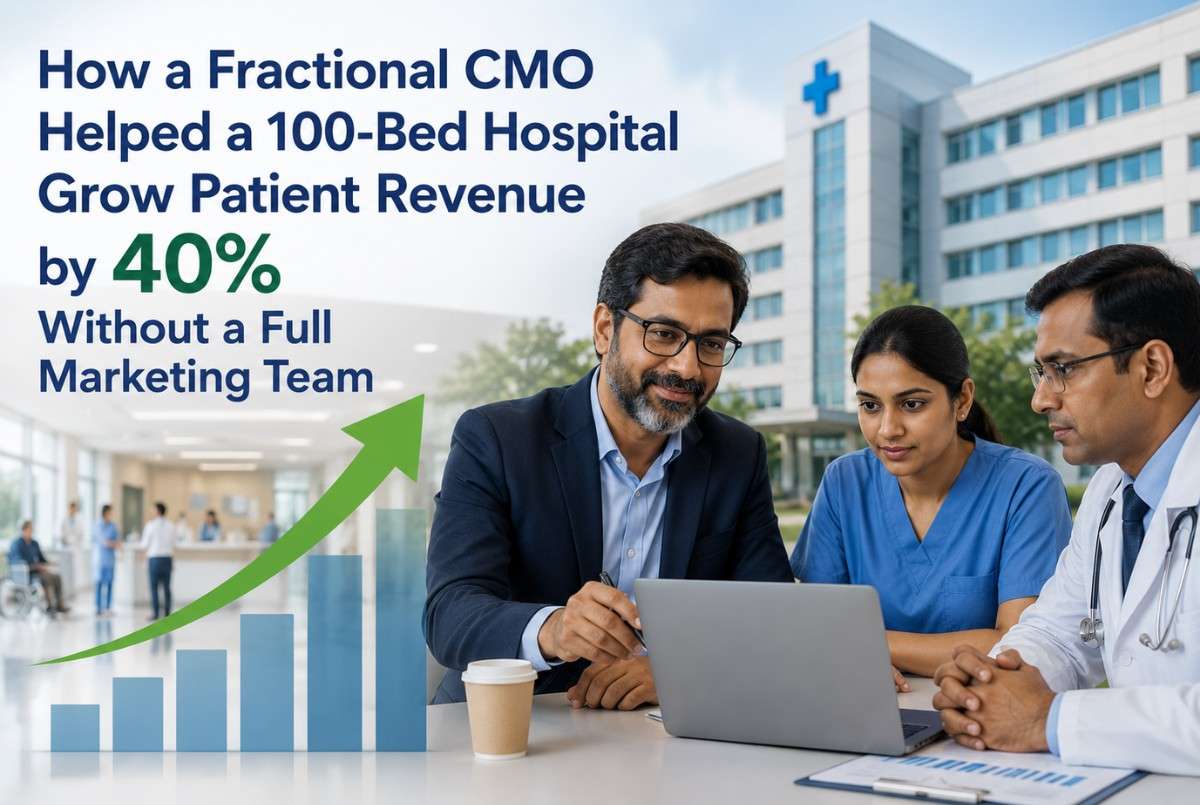
How a Fractional CMO Helped a 100-Bed Hospital Grow Patient Revenue by 40% Without a Full Marketing Team
Opening
A few years ago, a hospital administrator from a mid-sized town in Andhra Pradesh called me in a state of quiet desperation. His hospital had 100 beds, a genuinely strong surgical team, and a location that should have been an advantage. He had been running for four years. Occupancy was stuck at 42%. He had tried two agencies. He had a Facebook page with decent followers. He had even printed a glossy brochure.
Nothing was moving.
When I asked him what his patient acquisition strategy was, he described his marketing spend. Those are not the same thing. And that distinction — between spending money on marketing and having a strategy that drives fractional CMO hospital growth in India — is the entire difference between a hospital that survives and one that thrives.
What followed over the next 12 months was not a marketing miracle. It was structured, unglamorous work. The kind that most agencies will not do because it does not fit into a monthly retainer model. By the end, his occupancy had crossed 72% and revenue had grown by over 40%.
This is what actually happened — and what you can learn from it.
The Real Problem
The hospital industry in India has a dangerous blind spot. Most owners measure their marketing investment by what they spend, not by what it produces. So when growth stalls, the instinct is to spend more — more ads, more platforms, more vendors.
I have watched this play out in Chennai, in Vijayawada, in Madurai, in Nashik. The pattern is almost identical every time. The hospital increases the digital budget. The agency delivers a report showing improved reach. OPD numbers stay flat. The owner concludes that marketing does not work in their market, or that patients in their area are not digitally active, or that competition is simply too intense.
None of those conclusions are usually correct.
The real issue is that marketing spend without marketing leadership produces noise, not growth. Someone needs to be responsible for the strategy — for deciding which patient segments to prioritize, which referral channels to invest in, how the hospital’s reputation is being shaped in the community, and whether any of the spend is connecting to actual admissions.
Here is the assumption I want to challenge directly: a hospital does not need a bigger marketing budget. It needs someone accountable for marketing outcomes. For a 100-bed hospital in India, hiring a full-time CMO at ₹35–50 lakh per year is rarely viable and often unnecessary. What works is fractional marketing leadership — experienced, senior, and structured around results.
How Fractional CMO Hospital Growth Actually Works: The 4-Phase Framework
This is not a theoretical model. It is the sequence I used with that hospital in Andhra Pradesh, and variations of it across dozens of engagements in South India.
Phase 1: The Honest Audit (Weeks 1 to 4)
Before any strategy is built, I look at what is actually happening. Not what the hospital thinks is happening. What the data says.
This means pulling 12 months of OPD registration data and mapping it by source — walk-in, referral, digital inquiry, repeat visit. It means interviewing the front desk staff, because they hear things no administrator ever does. It means reading every Google review written in the last year, including the ones the hospital has tried to suppress. It means sitting with the top three doctors and understanding how they think about their own patient base.
In this particular case, the audit revealed three things the owner did not know. First, 60% of new patients were coming through GP referrals, but there was no structured program to nurture or expand that network. Second, the front desk was losing nearly one in three phone inquiries because calls were going unanswered during peak hours. Third, the hospital’s strongest clinical offering — a bariatric surgery program — had almost no visibility in the local market despite being genuinely differentiated.
None of these problems would have been solved by more Instagram posts.
Phase 2: Strategic Positioning (Weeks 4 to 8)
Once the audit is complete, the work is to define what the hospital actually stands for in its market — clearly enough that a patient in a semi-urban area with multiple hospital options has a specific reason to choose it.
For this hospital, we built the positioning around three things: the bariatric program, a genuine commitment to transparent pricing, and a strong network of trusted local GPs. Each of these was real. None of them were being communicated consistently or credibly.
This is where most fractional CMO engagements deliver immediate value that no agency can replicate. An agency will position a hospital however the brief tells them to. A fractional CMO interrogates what is actually true and builds from there — because in Indian healthcare, patients are sophisticated enough to detect the gap between what a hospital claims and what it delivers.
Phase 3: Channel and Referral Architecture (Weeks 8 to 16)
With positioning defined, the next step is building the actual acquisition infrastructure.
For this hospital, that meant three parallel workstreams. The GP referral program was structured as a quarterly engagement series — not gifts or commissions, which create compliance risk, but clinical education sessions that positioned the hospital’s specialists as genuine partners. Within six months, active referring GPs had grown from 18 to 47.
The digital channel was rebuilt around search intent — patients in the catchment area searching for specific procedures, not generic hospital queries. Ad spend actually decreased by 30% while inquiry volume increased, because we stopped running awareness campaigns and started running conversion campaigns with proper tracking.
The front desk issue was addressed with a simple operational fix: a dedicated inquiry management protocol with callback commitments and a WhatsApp intake process for patients who preferred not to call.
Phase 4: Metrics and Accountability (Ongoing)
The final piece — and the one most hospitals have never had — is a dashboard that connects marketing activity to revenue outcomes. Not reach, not impressions, not follower growth. Cost per OPD visit by channel. Conversion rate from inquiry to admission by procedure category. Referral source breakdown month on month.
When a hospital’s leadership team can see this data, conversations with agencies and vendors change completely. Underperforming channels get cut. High-performing ones get more investment. The guessing stops.
What the Numbers Looked Like at Month 12
Metric | Before | After 12 Months Bed Occupancy | 42% | 72% Active Referring GPs | 18 | 47 Monthly OPD Registrations | 380 | 610 Digital Ad Spend | ₹1.8 lakh/month | ₹1.2 lakh/month Patient Revenue Growth | Baseline | +40%
What This Changes
When fractional marketing leadership is applied correctly, the shift goes beyond revenue numbers.
In the short term — within 90 days — the hospital stops operating in reactive mode. There is a strategy. There is someone accountable for it. Vendors stop managing themselves. The front desk starts converting inquiries instead of losing them. Doctors who had felt invisible in their market begin to see their consultation load grow.
Over 12 months, something more significant happens. The hospital builds a reputation that compounds. Patients who came through a GP referral become repeat patients who send family members. Google reviews improve because the patient experience has been tightened. The hospital develops a market position that is difficult for a competitor to copy quickly.
The administrator in Andhra Pradesh told me something I have heard in different forms from many clients: “I finally feel like I am running a hospital, not chasing a marketing problem every month.”
That is what structured hospital growth consulting in India should produce. Not just revenue. Clarity.
How Chitra Works on This
Every engagement I take begins with the same commitment: I will tell you what I actually find, not what you want to hear. If your marketing problem is really an operations problem, I will say so. If your positioning is weak, I will show you the evidence. If your agency is underdelivering, we will address it directly.
What most clients do not expect is how much of the first month is spent listening — to staff, to patients, to the data that has never been properly read. Hospitals accumulate a remarkable amount of diagnostic information that never gets used. OPD records. Discharge summaries. Complaint logs. Feedback forms. That information tells a story. My job is to read it accurately and build a strategy from what is true, not what is assumed.
I work directly with hospital leadership. The strategy I design, I also implement alongside your team.
If you are running a hospital between 30 and 200 beds and you are not sure whether your current marketing approach is working, start with my free Hospital Revenue Readiness Assessment — a 15-minute diagnostic tool that maps your current acquisition channels, referral health, and conversion gaps. It will show you exactly where the leakage is before we speak.
Closing
A 100-bed hospital does not need a full marketing department to strategise. It needs one experienced person who knows what questions to ask, what the data actually means, and how Indian healthcare patients actually make decisions.
That is the fractional model. And when it is done properly, 40% revenue growth in 12 months is not an outlier. It is a result that a structured approach consistently makes possible.
If your hospital is ready for that conversation, book a free 30-minute strategy call. We will look at your specific numbers and I will tell you honestly what I see.
Frequently Asked Questions
How does a fractional CMO drive hospital revenue growth in India?
A fractional CMO builds and executes a patient acquisition strategy tailored to the hospital’s specific market, referral network, and clinical strengths. Unlike agencies that focus on campaign execution, a fractional CMO owns the full growth strategy — from positioning to channel selection to vendor accountability — directly connecting marketing activity to revenue outcomes.
What results can a hospital expect from fractional CMO consulting in India?
Results vary by hospital size, market, and starting point. Hospitals with strong clinical teams but weak marketing infrastructure typically see OPD volume improvements within 90 days. Revenue impact of 25–45% over 12 months is achievable when the engagement covers strategy, referral development, and operational fixes together — not marketing spend alone.
How is outsourced marketing leadership for hospitals different from hiring an agency?
An agency executes campaigns. Outsourced marketing leadership, or a fractional CMO, owns the strategy that determines what campaigns get built and why. The fractional CMO also manages the agency, defines KPIs connected to revenue, and makes decisions about positioning and patient acquisition that no agency has the authority or context to make.
What does a fractional CMO look at first when working with a hospital in India?
The first step is always an audit — OPD source data, referral network composition, front desk conversion rates, online reputation, and existing vendor performance. Most hospitals discover that their biggest growth leaks are operational, not marketing. Fixing those before increasing spend is what separates effective hospital growth consulting from expensive noise.
Is fractional CMO engagement suitable for hospitals outside metro cities in India?
It is often more impactful for hospitals in Tier 2 and Tier 3 cities than for metro hospitals. Semi-urban markets have stronger GP referral dynamics, less competitive digital environments, and greater dependence on community trust signals. A fractional CMO who understands these market realities can deliver outsized results precisely because the competition has not yet built structured marketing leadership.