Need help now? Call for a same-day consultation



Patient Experience vs Patient Satisfaction — Why Indian Hospitals Confuse the Two and Pay the Price
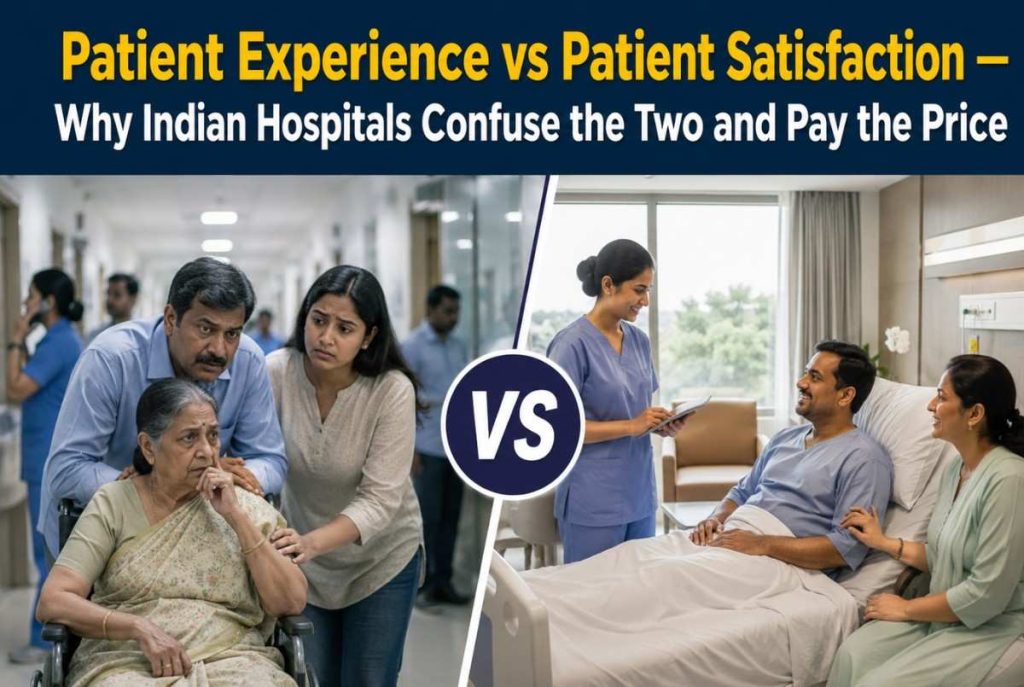
A patient leaves your hospital with a smile, completes a satisfaction survey with top scores, and never returns. No complaint was filed. No bad review was posted. Yet something in that care journey failed to build lasting trust. This pattern plays out across Indian private hospitals every day — and most leadership teams cannot explain it. Every skilled patient experience consultant India healthcare leaders work with will point to the same root cause: satisfaction and experience are not the same thing, and confusing them costs hospitals far more than they realise.
Why Satisfaction Scores Are Giving Indian Hospitals a False Sense of Security
Hospital patient satisfaction India measurements typically capture how a patient felt at discharge — whether the food was acceptable, whether staff were polite, whether the bill was explained. These are important data points. But they measure a moment, not a journey.
Patient experience, by contrast, encompasses every interaction a patient has with a hospital — from the first Google search to the follow-up call three weeks post-discharge. It includes how long they waited, whether they understood their diagnosis, how safe they felt, and whether they trusted the team caring for them.
A patient can score a hospital eight out of ten on a satisfaction survey and still choose a different hospital for their next procedure. Satisfaction measures contentment. Experience measures connection. Only one of those drives retention, referrals, and long-term revenue.
The Framework: Understanding What Patient Experience Actually Measures
Chitra Baskar’s consulting work with medical directors and quality heads across India consistently returns to a foundational distinction — satisfaction is transactional, experience is relational. Building one without the other leaves significant patient retention value on the table.
Her framework maps the patient experience across five critical stages:
- Pre-Arrival — How easy was it to find information, book an appointment, and understand what to expect? Friction here creates anxiety before the patient even enters the building.
- Arrival and Reception — First physical impressions, waiting time management, and the tone set by front-desk staff. These moments disproportionately shape overall perception.
- Clinical Interaction — Did the patient feel heard? Was their condition explained in language they understood? Did the care team demonstrate both competence and empathy?
- Discharge and Transition — Was the discharge process clear? Did the patient leave knowing what to do next, who to call, and when to return?
- Post-Discharge Follow-Up — Did the hospital reach out proactively? This stage is almost universally neglected by Indian hospitals and represents one of the strongest patient trust building strategies India hospital teams can implement immediately.
Patient engagement strategies for Indian hospitals that address all five stages consistently outperform those that focus only on in-hospital satisfaction. Patient journey mapping for hospitals India quality teams conduct is the practical tool that makes this framework actionable.
Four Steps to Shift From Satisfaction Measurement to Experience Design
Step 1: Replace exit surveys with journey audits. A discharge satisfaction form captures one moment. A patient journey audit maps friction, confusion, and disconnection across every touchpoint. Conduct structured interviews with recently discharged patients — not just forms — to surface what surveys miss.
Step 2: Train clinical and non-clinical staff differently. Satisfaction training focuses on politeness. Experience training focuses on communication — explaining procedures, acknowledging anxiety, and making patients feel informed at every stage. The distinction matters in how training is designed and delivered.
Step 3: Build a post-discharge contact protocol. A structured follow-up call within 48 to 72 hours of discharge — checking on recovery, answering questions, and confirming medication compliance — does more for patient loyalty than any lobby renovation. Understanding how to improve patient experience in Indian hospitals starts here.
Step 4: Close the feedback loop visibly. When patients see that their feedback led to a visible change, trust deepens. Communicate improvements back to the community through social media, notice boards, or newsletters. This signals that the hospital listens — and acts.
Mistakes That Keep Hospitals Stuck at Satisfaction Without Reaching Experience
Treating NABH accreditation as the finish line. Accreditation sets a compliance baseline. It does not guarantee that patients feel genuinely cared for, understood, or valued. Hospitals that stop at accreditation miss the relational layer entirely.
Measuring only what is easy to measure. Net Promoter Scores and discharge ratings are simple to collect. Emotional trust, communication clarity, and care continuity are harder to quantify — but far more predictive of patient retention. What gets measured shapes what gets managed.
Assigning experience to one department. Patient experience is not the responsibility of the quality team or the marketing department alone. It is an organisation-wide discipline that requires alignment across clinical, operational, and administrative functions. Siloed ownership produces siloed results.
Satisfaction Gets Patients to Leave Quietly — Experience Gets Them to Come Back
The hospitals that build sustainable patient loyalty in India are not necessarily the ones with the highest satisfaction scores. They are the ones that design every stage of the patient journey with intention, empathy, and follow-through. That is what a patient experience consultant India healthcare leaders rely on helps build — not just better surveys, but better systems.
If your hospital is ready to move beyond satisfaction metrics and build a patient experience framework that drives genuine retention, Chitra Baskar offers focused consulting for medical directors, quality heads, and CEOs across India. Connect with her on LinkedIn or book a discovery call to begin exploring patient journey mapping for hospitals India that creates lasting patient trust.
What does a healthcare business growth consultant do?
A healthcare business growth consultant helps hospitals, clinics, and healthcare entrepreneurs identify revenue gaps, streamline operations, build leadership capacity, and create clear, actionable strategies to grow their organisation sustainably and profitably.
Why do healthcare businesses in India need a growth consultant?
India’s healthcare sector is competitive and rapidly evolving. Many providers have clinical excellence but lack the business strategy, systems, and leadership structures to scale. A specialist consultant bridges that gap — delivering growth without compromising patient care quality.
Who is Chitra Baskar?
Chitra Baskar is a healthcare business growth consultant based in India, working with hospitals, clinic owners, and healthcare entrepreneurs to scale revenue, build strong teams, and create future-ready healthcare organisations through personalised strategy and executive coaching.
What services does Chitra Baskar offer?
Chitra Baskar offers revenue growth strategy, hospital business consulting, brand positioning, leadership and executive coaching, operational excellence frameworks, strategic business planning, and healthcare startup mentoring for clients across India.