Need help now? Call for a same-day consultation
Chitra Baskar | Healthcare Marketing Consultant India


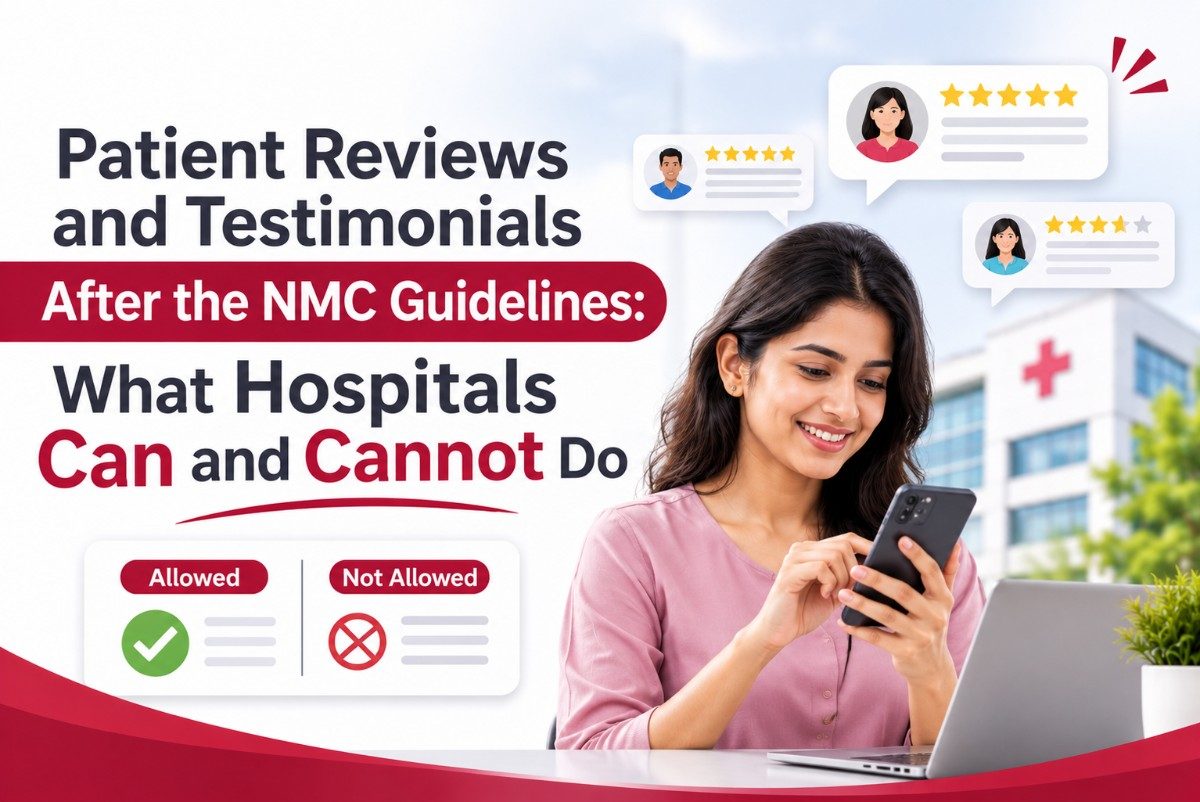
Patient Reviews and Testimonials After the NMC Guidelines: What Hospitals Can and Cannot Do
For years, patient stories, video thanks and transformation photographs did the heavy lifting for many specialty clinics. The patient testimonials NMC guidelines now treat very differently, and the confusion is real. Owners are asking whether they must pull everything down, whether a Google review request is still safe, and whether any before-and-after image can stay. This guide separates what the reports clearly say from what remains unsettled, and shows how to keep earning patient trust without relying on testimonials.
A note on sources: the points below come from press reports and commentary on the notice, not the official text. Please read the notice and take legal advice before acting.
What the Guidelines Reportedly Say
The National Medical Commission’s Guidelines on Ethical Advertising and Public Communication, issued in early October, apply to registered medical practitioners, hospitals, medical institutions and clinical establishments. Based on consistent reporting:
- Practitioners may not use or permit patients, celebrities, influencers, employees or other third parties to promote professional services through prohibited testimonials, endorsements or recommendations.
- Practitioners should not request or share patient testimonials, recommendations, endorsements or reviews for professional promotion on social media.
- Hospitals and doctors may not procure, manipulate or cause others to procure or manipulate fake or paid reviews, ratings, followers, likes, comments or views.
- AI cannot be used to create synthetic patient testimonials, voices, clinical outcomes or endorsements.
- Promotional before-and-after photographs and success stories are prohibited. Reports say patient consent does not change this.
- Using an agency or influencer does not remove your responsibility for content you commissioned or knowingly allowed.
Can Hospitals Use Patient Testimonials in India?
For promotion, the answer now appears to be no. The test is purpose, not format. A testimonial used to attract patients is the concern, whether it appears as a written quote, a video, an audio clip or a screenshot of a message.
Common practice | Likely position |
Patient video thanking the doctor | Promotional testimonial; high risk |
Written patient quotes on service pages | High risk |
Star-rating widget or review slider on your website | High risk, since it republishes patient opinion for promotion |
Doctor reposting a patient’s story | High risk |
Relative, employee or celebrity endorsement | Specifically restricted |
AI-created patient story or voice | Prohibited |
Paid or incentivised reviews | Prohibited |
Consent does not rescue a prohibited testimonial. It matters only for uses that are otherwise permitted.
Are Before and After Photos Allowed for Doctors in India?
Reports say promotional before-and-after photographs and success stories are prohibited. That reaches hardest into dermatology, aesthetics, dental and some orthopaedic and fertility practices, where visual results have been central to marketing.
A consultancy summary mentions an educational or scientific exception using anonymised, consented images. I could not verify this against the official text, so I would not rely on it for a public campaign. A careful position is to remove result galleries from marketing channels and take advice before using any clinical image, even for education.
Replace them with content that explains the condition, how assessment works, what a procedure involves, what recovery generally looks like and when to seek care, without implying a particular outcome. Patient images also raise privacy duties, which continue regardless of advertising rules.
Can Hospitals Ask Patients for Google Reviews?
This is where reading carefully matters, because different sets of rules apply. Google’s policy states that fake engagement and paid or incentivised reviews are not allowed and that businesses should not selectively solicit positive reviews, while genuine reviews can be requested without incentives. The NMC reports say practitioners should not request or share patient reviews for professional promotion on social media. The coverage I reviewed does not state how this applies to a neutral request on a public review platform, and it does not directly address reviews that patients post without being asked.
Until there is clarification, I would take this approach:
- Never offer a reward, discount or favour for a review, or for changing it.
- Never pick only the patients likely to be happy.
- Do not copy reviews into your website, reels, advertisements or messages.
- Pause active, campaign-style review drives until your adviser confirms your position.
- Do not buy, write or arrange reviews through staff, relatives or agencies.
If you are asking whether hospital Google reviews are covered by the rules in India, the honest answer is that the fake and paid review position is clear, while the treatment of genuine, unsolicited reviews is not.
Patient Review Management for Hospitals: A Safer Model
Move from collecting praise to managing feedback.
Gather Feedback Privately
Use an internal feedback process at discharge or after consultation. It tells you what to fix, and it carries no promotional purpose.
Respond Carefully to Public Reviews
If you reply at all, keep it brief, courteous and free of clinical detail. Do not confirm that someone was a patient or discuss their treatment publicly. This is my practical caution based on privacy duties, not a rule I can quote from the notice.
Close the Loop Internally
Review complaints and delays on a regular schedule, and assign each pattern to an owner. Poor waiting times, unclear billing and weak follow-up usually drive negative reviews more than clinical quality does.
Control Your Agencies
Ask your agency to confirm in writing that it neither creates nor purchases reviews, testimonials or engagement for you.
Building Trust Without Testimonials
You still have credible signals that remain permitted: accurate doctor credentials and registration details, factual information on facilities and equipment, accreditation status, clear charges, and educational content from named clinicians. Referral relationships with other doctors, built through clinical communication and never through payments, are often the most durable source of patients for a specialty clinic.
Frequently Asked Questions
Is a patient’s thank-you message safe to display? Reports suggest it should not be used for promotion, even if the patient agrees.
Can I answer a review on Google? The reports I reviewed do not address replies. Keep any reply free of patient detail and confirm with your adviser.
Do these rules apply to small clinics? Yes. Individual practitioners and clinical establishments are reportedly covered.
Where Growth Comes From Next
Losing testimonials does not have to cost you patients, but it does mean growth must come from stronger foundations: how enquiries are handled, how quickly patients are seen, how well they are followed up and how deeply you are embedded in your referral network. If you run a specialty clinic and want a practical, compliant plan for patient acquisition and growth, I would be glad to hear from you. I am Chitra Baskar, a healthcare growth consultant based in Chennai. Please reach out through the contact details on this website.