Need help now? Call for a same-day consultation


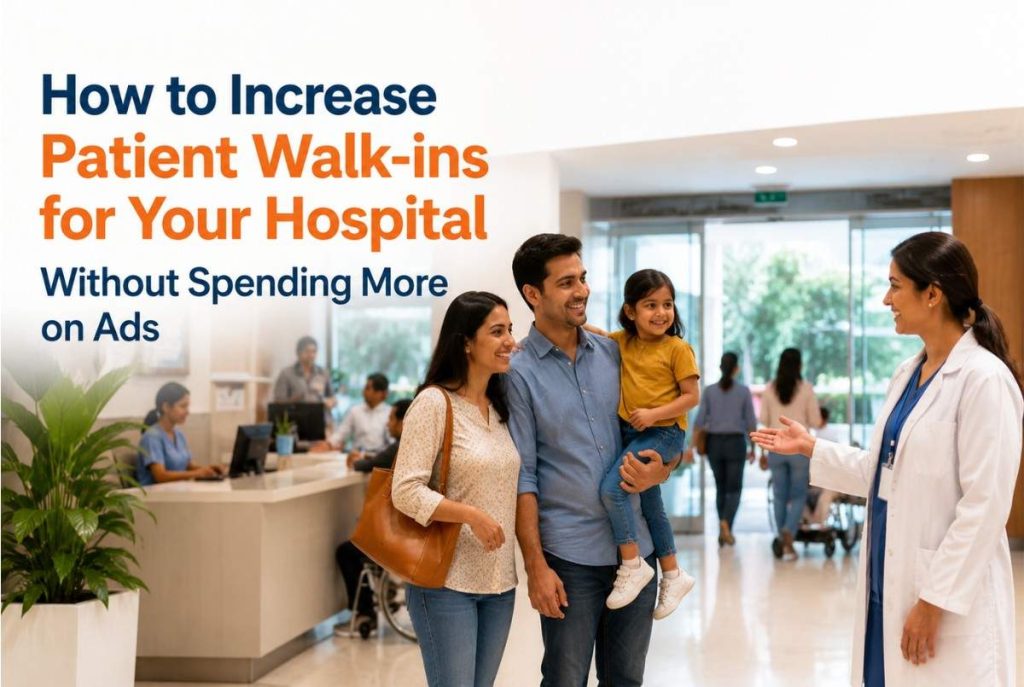
How to Increase Patient Walk-ins for Your Hospital Without Spending More on Ads
I remember walking into a 75-bed hospital in a mid-sized town in Tamil Nadu where the administrator proudly showed me their monthly ad spend — ₹1.8 lakh across Google, Facebook, and a local cable television slot. Then he showed me the OPD register. Footfall had actually dropped 12% over the previous six months despite the increased spending.
We spent the next hour talking to the front desk staff, the security guard at the entrance, and three patients waiting in the OPD queue. By the end of that hour, the problem was completely clear. And not one part of it had anything to do with advertising.
If you are trying to increase patient walk-ins for your hospital in India and your first instinct is to increase your ad budget, I want to slow you down. Not because advertising does not work. It does, when the fundamentals are right. But in thirty years of working inside Indian healthcare — from Apollo Hospitals to independent nursing homes across South India — I have rarely seen a footfall problem that more advertising alone could solve.
The patients are out there. The question is why they are not walking through your door. And the answer is almost always found closer to home than any agency dashboard will show you.
The Real Problem
The standard advice for increasing hospital patient footfall goes something like this: improve your Google My Business listing, run targeted Facebook ads, post more health content on Instagram, and invest in search engine optimization.
That advice is not wrong. But it is dangerously incomplete for the Indian healthcare context — and following it without addressing what is happening inside your hospital first is like painting the front door of a house that has a broken foundation.
Here is what most hospitals in India do not want to acknowledge: the majority of patient footfall problems are not marketing problems. They are trust problems, referral problems, and experience problems. And no amount of digital spend repairs any of those.
Consider this. In semi-urban Tamil Nadu, Kerala, and Andhra Pradesh, the single most powerful driver of hospital choice is still word of mouth — either from a trusted GP or from a family member who has been treated at the hospital before. A patient in Tirunelveli choosing between two hospitals of similar size is not making that decision based on which one has a better Instagram page. They are making it based on what their neighbour said, what their family doctor recommended, or what they heard at the temple last Sunday.
That is the real acquisition channel. And it runs entirely on reputation, relationships, and experience — none of which can be purchased through an ad platform.
The bold truth is this: hospitals that have cracked organic patient growth in India have not outspent their competitors. They have out-trusted them.
Five Ways to Increase Patient Walk-ins Without Increasing Your Ad Spend
- Fix What Happens in the First Five Minutes
The most powerful patient acquisition tool your hospital has is the experience of every patient who walks through your door today. Because in Indian healthcare, one patient’s experience typically influences the decisions of 8 to 15 people in their immediate social network — family, friends, colleagues, neighbours.
I have audited hospitals where the clinical care was genuinely excellent and the marketing was failing. In almost every case, the front desk experience was the problem. Patients waited 25 minutes to register. Staff were indifferent. The OPD queue system was chaotic. Nobody acknowledged that a first-time patient might be anxious.
Fix the first five minutes and you fix your most powerful marketing channel. This means: a warm, efficient registration process, clear signage, a designated person to orient new patients, and a system that communicates wait times honestly. These cost nothing beyond intention and training. Their impact on referral generation is immediate.
- Build a Structured GP Referral Program
In South India, GP referrals are the arterial system of hospital patient flow. Yet most hospitals treat their GP relationships casually — a Diwali gift here, an occasional phone call there, a sponsored CME once a year if the budget allows.
That is not a referral program. That is relationship maintenance at minimum viable effort.
A structured GP referral program means knowing exactly which GPs in your 10-kilometre catchment area are active referrers, which ones referred patients in the past but have stopped, and which ones have never referred but serve a patient population that matches your specialties.
It means scheduling quarterly clinical engagement sessions where your specialists share genuine clinical knowledge — not promotional content — with these GPs. It means creating a simple, respectful feedback loop where a GP who refers a patient receives an update on that patient’s outcome. That one practice alone, done consistently, builds more referral loyalty than any advertising campaign.
I worked with a hospital in Coimbatore that increased active referring GPs from 22 to 61 over 14 months purely through structured engagement — no gifts, no commissions, nothing that would raise a compliance concern under NMC guidelines. Monthly OPD registrations grew by 38% in that period.
- Activate Your Discharged Patient Base
Every patient your hospital has ever discharged is a potential ambassador — or a lost opportunity. Most hospitals treat discharge as the end of the relationship. It should be the beginning of the retention and referral phase.
A simple post-discharge follow-up protocol — a phone call at day 3, a WhatsApp message at day 10, a reminder for the follow-up consultation at day 30 — does three things simultaneously. It catches any post-discharge concerns before they become complaints. It demonstrates that the hospital genuinely cares about outcomes, not just billing. And it keeps the hospital present in the patient’s mind at exactly the time when family members and friends are most likely to ask them for a healthcare recommendation.
The cost of this program is one trained staff member and a basic tracking system. The return, in repeat visits and referrals generated, consistently outperforms equivalent ad spend in every hospital I have seen implement it seriously.
- Own Your Community Presence
This is the strategy most overlooked by hospital marketing advice — and the most powerful for Tier 2 and Tier 3 hospitals across India.
Community presence means that your hospital’s doctors are visible, trusted, and accessible to the community before a medical crisis occurs. It means health camps in residential areas, schools, and workplaces. It means your cardiologist speaking at the local Lions Club meeting about heart health. It means your gynecologist running a free antenatal awareness session at a community centre.
None of this requires significant budget. It requires time, intention, and the understanding that in Indian healthcare, trust is built before illness arrives — not after.
Hospitals that invest consistently in community presence build a default preference that advertising cannot buy. When a patient in that community needs hospital care, the choice is not a search engine decision. It is already made.
- Convert Your Google Reviews Into a Growth Engine
Your Google My Business profile is the one digital asset that directly influences walk-in decisions in India. Not Instagram. Not Facebook. Google — because it is what a patient or their family member checks at the exact moment they are deciding where to go.
Most hospitals have between 40 and 120 reviews. Most of those reviews were left spontaneously, skewing toward complaints. And most hospitals have no system for encouraging satisfied patients to share their experience.
The fix is simple and fully compliant with Indian advertising standards: train your front desk and nursing staff to mention the Google review option to patients at discharge — not as a request for positive reviews, but as an invitation to share their honest feedback. Pair this with a QR code at the billing counter linking directly to your review page.
Hospitals that go from 80 to 300+ quality reviews over 12 months see measurable increases in walk-in inquiries from patients who had no prior relationship with the hospital. That is organic patient growth strategy working at its most basic and most effective.
Organic vs Paid Patient Acquisition: Where Each Works Best
Channel | Cost | Speed | Sustainability | Best For |
GP Referral Program | Low | Medium (3–6 months) | Very High | Admissions, surgeries, specialist consultations, procedures |
Discharge Follow-up | Very Low | Fast (30–60 days) | High | Repeat visits, patient retention, referrals from satisfied patients |
Community Presence | Low–Medium | Slow (6–12 months) | Very High | Building trust, reputation, and increasing walk-in patients |
Google Reviews | Negligible | Medium | High | First-time patients comparing hospitals or clinics online |
Paid Digital Ads | High | Fast | Low | Awareness, service launches, seasonal campaigns, quick patient acquisition |
What This Changes
When these five strategies are implemented with consistency — not as one-off initiatives but as ongoing operational commitments — the shift in patient footfall is both measurable and durable.
Within 60 days, the discharge follow-up program starts generating return visits and referral conversations. Google reviews begin improving because someone is now actually managing them. The front desk experience tightens because staff know it is being measured.
Within six months, GP referrals increase because the relationship program has had time to build genuine trust. Community visibility starts shifting default preference in the catchment area. OPD slots that were habitually empty start filling from sources that have nothing to do with ad spend.
Within 12 months, the hospital has built a patient acquisition infrastructure that compounds. Each new patient who has a good experience feeds the referral network. Each GP who trusts your specialist sends more patients. Each community health camp creates a new cohort of people who know your hospital’s name before they need it.
This is how hospitals in India that are not outspending their competitors are still outgrowing them.
How Chitra Works on This
When I work with a hospital on organic patient growth, the first thing I map is the current referral ecosystem — where patients are actually coming from, which sources are growing, which are declining, and which have never been properly activated.
What most hospital owners discover in this mapping exercise is that they have been investing in the weakest channels and neglecting the strongest ones. They have been spending on digital advertising while their GP referral network quietly erodes. They have been posting on Instagram while their discharged patients receive no follow-up contact whatsoever.
The audit takes two weeks. The strategy it produces is specific to the hospital’s geography, specialty mix, and patient demographics — not a generic plan that could apply to any hospital anywhere.
I do not believe in 20-point action plans that overwhelm without delivering. I work with hospitals to identify the three highest-leverage changes that will produce visible results within 90 days, then build from that momentum.
If you want to start that process yourself, download my free Patient Footfall Diagnostic — a structured self-audit that maps your current referral sources, discharge follow-up gaps, and community visibility in under 20 minutes. It will show you exactly where your growth is being left on the table before we speak.
Closing
More ad spend is not the answer to a patient footfall problem that is rooted in trust, relationships, and experience. The hospitals that crack organic growth in India are not the ones with the biggest budgets. They are the ones that take their existing patients seriously enough to earn their loyalty and their referrals.
That is the strategy. And it is available to any hospital willing to implement it with consistency.
If you want to look at your specific numbers and identify exactly where your growth gaps are, book a free 30-minute strategy call and we will work through it together.
Frequently Asked Questions
How can a hospital increase patient walk-ins without spending more on ads in India?
By investing in the three channels that produce the highest organic growth in Indian healthcare: structured GP referral programs, post-discharge patient follow-up protocols, and consistent community presence. These channels build trust-based patient acquisition that compounds over time — unlike paid advertising, which stops producing results the moment spend stops.
What is the fastest way to increase hospital patient footfall in India?
Fixing the front desk experience and implementing a post-discharge follow-up program produce results fastest — typically within 30 to 60 days. Both tap into existing patient relationships rather than requiring new acquisition. A patient who has a good experience and receives a follow-up call is significantly more likely to return and refer others within weeks.
How do GP referrals help increase hospital patient walk-ins?
GP referrals drive 40% to 65% of hospital admissions in many Indian markets, particularly in Tier 2 and semi-urban areas. A structured quarterly engagement program that treats GPs as clinical partners — not just referral sources — consistently increases active referring GPs and the patient volumes they direct, without any advertising spend.
Do Google reviews actually increase patient walk-ins for hospitals in India?
Yes. For first-time patients with no prior relationship to a hospital, Google reviews are the primary trust signal consulted before visiting. Hospitals that grow from under 100 to 300+ quality reviews — through a structured but compliant review invitation process — typically see measurable increases in walk-in inquiries from new patients within four to six months.
Why is community presence important for organic hospital patient growth in India?
In Indian healthcare, patients default to hospitals they have already heard of in a trusted context before a health crisis occurs. Community health camps, doctor talks at local organizations, and school health programs build this default preference at low cost. For Tier 2 and Tier 3 hospitals especially, community visibility consistently outperforms equivalent digital ad spend in driving sustainable walk-in growth.