Need help now? Call for a same-day consultation



How Tier 2 City Hospitals in India Can Compete with Corporate Chains
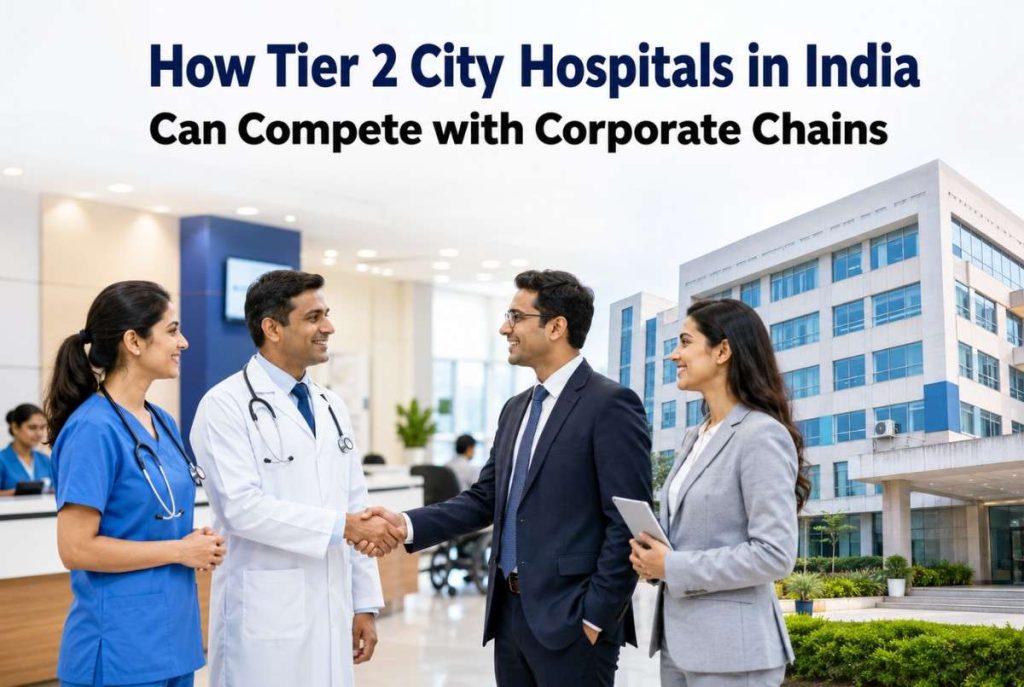
The arrival of a corporate hospital chain in a Tier 2 city does not have to signal the decline of independent healthcare. Many hospital owners respond with anxiety — cutting prices, rushing renovations, or simply hoping loyalty holds. None of these work consistently. What works is a structured clinic expansion strategy Tier 2 cities India independent hospitals can own — one that plays to their genuine strengths rather than imitating what corporate chains already do better.
Why Independent Hospitals Are Losing Ground — And What Is Actually Driving It
The challenge from chains of hospitals is real, but it is frequently misunderstood. Patients are not leaving independent hospitals purely because corporate facilities are clinically superior. In many cases, they are not Apollo, Fortis, and Manipal.
What corporate chains offer is a packaged confidence — consistent signage, structured communication, digital convenience, and the reassurance of a nationally expanded name. Independent hospitals, despite decades of service and strong community relationships, often fail to communicate their value with the same clarity.
This is fundamentally a private hospital marketing India challenge. Owners who diagnose it correctly stop trying to match corporate infrastructure and start investing in differentiated positioning that corporate chains genuinely cannot replicate at scale.
The gap is not in capability or care quality. It is in how that quality is perceived, communicated, and experienced by patients at every touchpoint.
The Strategic Framework: Four Advantages Independent Hospitals Must Own
Chitra Baskar’s work with independent hospitals across Tier 2 and Tier 3 cities consistently identifies four areas where independent owners hold structural advantages — if they choose to develop them intentionally.
- Proximity and Personalised Care Corporate chains optimise for throughput. Independent hospitals can optimise for relationship. Direct consultant access, familiar faces at reception, personalised discharge calls — these details matter enormously to patients in smaller cities and cannot be systematised at corporate scale.
- Community Trust Accumulated Over Years An independent hospital that has served three generations of local families holds social capital that no marketing budget can manufacture. The strategy is to make that trust visible — through patient stories, community health initiatives, and consistent local presence.
- Specialty Focus Over Spread Rather than competing across every department, a focused clinic expansion strategy Tier 2 cities India owners implement successfully tends to anchor on one or two high-demand, high-trust specialties. Depth of reputation in one area outperforms breadth across many.
- Agility in Decision-Making Independent owners can respond to community needs, adjust pricing structures, onboard specialists, and redesign patient pathways far faster than a corporate chain bound by national protocols. This agility is a competitive asset that rarely gets leveraged.
Working with a hospital branding consultant India owners trust can translate these four advantages into a positioning strategy that is both distinctive and credible. A well-executed hospital marketing plan for South India, for instance, must account for language preferences, community health priorities, and local referral dynamics — none of which a national corporate template addresses well.
Four Practical Steps to Start Competing More Effectively
Step 1: Clarify your clinical identity. Identify the one or two specialties where your hospital has the strongest outcomes, consultant depth, or community reputation. Make these the centrepiece of all external communication and referral outreach.
Step 2: Redesign the patient experience at key touchpoints. Map the patient journey from first call to post-discharge follow-up. Identify where experience breaks down. Corporate chains set a baseline — independent hospitals can exceed it through personalisation, not infrastructure spend.
Step 3: Activate your referral network formally. Most independent hospitals in Tier 2 cities have informal referral relationships with local GPs and specialists. Formalising these — with structured engagement, clinical feedback loops, and regular communication — converts goodwill into consistent patient flow.
Step 4: Build a credible digital presence. Understanding how to compete with corporate hospitals in Tier 2 India requires being findable where patients search. A complete Google Business Profile, specialty-specific content, and genuine patient reviews are foundational — and entirely within reach for independent hospitals.
Three Mistakes That Accelerate the Decline
Competing on price. Discounting in response to a corporate entrant communicates insecurity, not value. It attracts price-sensitive patients while eroding the margins needed to sustain quality.
Copying the corporate aesthetic. Repainting lobbies or adding digital screens without fixing clinical communication or patient experience delivers no strategic benefit. Patients notice substance, not surface.
Remaining invisible locally. Independent hospitals that do not actively manage their community reputation — through events, health camps, social media, or local media — cede perception to competitors who do.
The Independent Hospital's Position Is Stronger Than It Feels
Corporate chains bring capital and brand recognition. Independent hospitals bring something built over years that capital cannot shortcut — community trust, clinical relationships, and local knowledge. A focused clinic expansion strategy Tier 2 cities India owners execute with clarity can convert those assets into a durable competitive position.
If you are an independent hospital owner navigating corporate competition and want a strategy built around your specific market, Chitra Baskar offers focused consulting for founders and owners across India. Connect with her on LinkedIn or book a discovery call — and begin building healthcare branding for independent hospitals Tier 2 cities that genuinely sets you apart.
What does a healthcare business growth consultant do?
A healthcare business growth consultant helps hospitals, clinics, and healthcare entrepreneurs identify revenue gaps, streamline operations, build leadership capacity, and create clear, actionable strategies to grow their organisation sustainably and profitably.
Why do healthcare businesses in India need a growth consultant?
India’s healthcare sector is competitive and rapidly evolving. Many providers have clinical excellence but lack the business strategy, systems, and leadership structures to scale. A specialist consultant bridges that gap — delivering growth without compromising patient care quality.
Who is Chitra Baskar?
Chitra Baskar is a healthcare business growth consultant based in India, working with hospitals, clinic owners, and healthcare entrepreneurs to scale revenue, build strong teams, and create future-ready healthcare organisations through personalised strategy and executive coaching.
What services does Chitra Baskar offer?
Chitra Baskar offers revenue growth strategy, hospital business consulting, brand positioning, leadership and executive coaching, operational excellence frameworks, strategic business planning, and healthcare startup mentoring for clients across India.