Need help now? Call for a same-day consultation
Chitra Baskar | Healthcare Marketing Consultant India


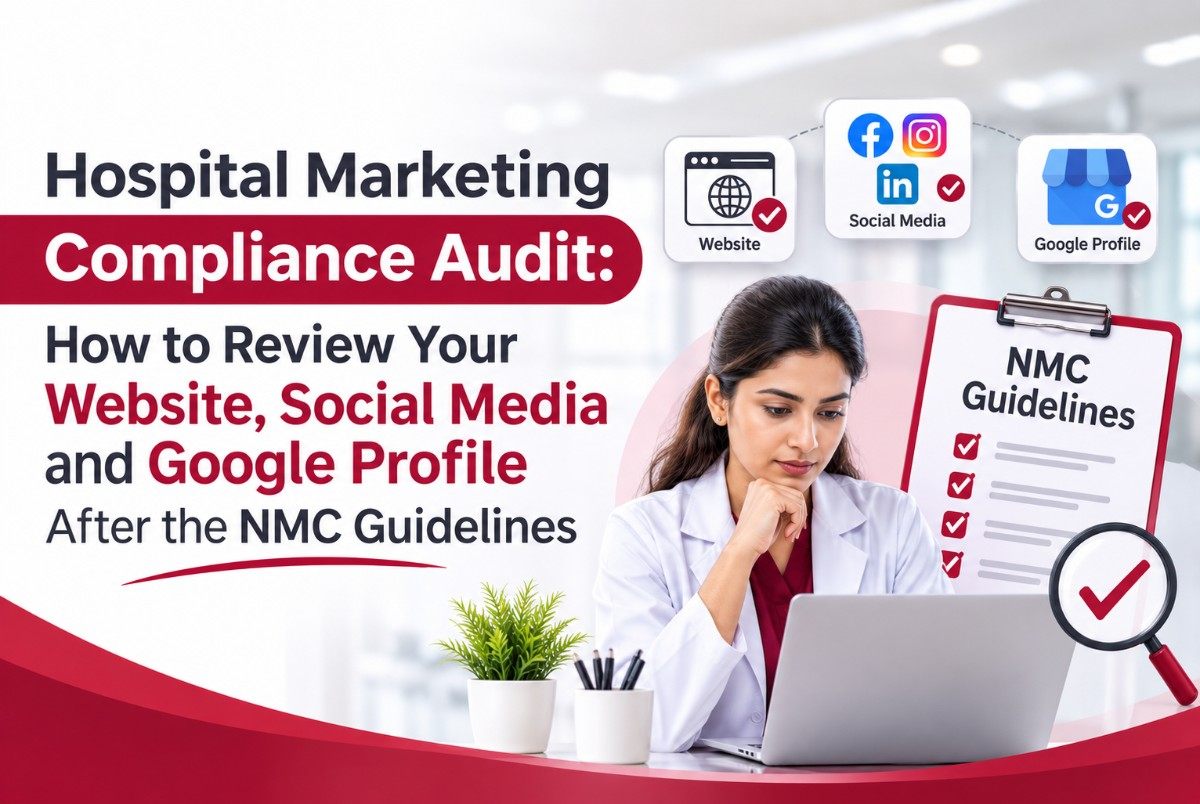
Hospital Marketing Compliance Audit: How to Review Your Website, Social Media and Google Profile After the NMC Guidelines
Most clinics do not know exactly what they have published. Over the years, a website, a few social accounts, an agency’s posts and a Google profile have piled up, often with patient stories, before-and-after images and bold claims. Since the NMC’s new advertising guidelines, any of it could become a problem. A hospital marketing compliance audit lets you find that content, judge its risk and fix it in an orderly way. This guide shows specialty clinic owners how to carry it out, step by step.
A note on sources: the regulatory points below come from press reports of the notice, not its official text. Please read the notice and take legal advice before acting.
Why an Audit Is Better Than a Quick Clean-Up
After a rule change, the usual reaction is to delete a few obvious posts. That leaves gaps. Content hides on old landing pages, scheduled posts, agency-run channels, pinned videos, directory listings and map profiles.
Some facts raise the stakes. The guidelines reportedly took effect in early October with no transition period mentioned, and they say nothing about reviewing existing content. Responsibility also stays with you for material an agency or influencer published on your behalf. A structured audit gives you a record of what you found and what you changed, which is useful if questions arise later.
How to Audit Hospital Marketing for NMC Compliance
Use a repeatable method across every channel.
Build an Inventory
List every place your clinic or doctors appear: website pages, blogs, landing pages, social accounts, messaging broadcasts, video channels, Google and map profiles, third-party doctor directories, and any account run by an agency or staff member. Record who owns each login.
Sort Each Item by Risk
Mark every piece of content red, amber or green.
- Red:clearly in conflict with the reported rules, such as guarantee claims, before-and-after images, patient testimonials or AI-generated patient content. Act on these immediately.
- Amber:unclear or context-dependent, such as superlatives, comparisons, offers or doctor photographs. Escalate these to your adviser.
- Green:factual, educational and verifiable.
Remediate and Record
Remove or rewrite red items, decide on amber ones, and keep a dated log of each change with the reason. Take screenshots before deletion. Do not edit content in a way that hides its history if you may need to explain it later.
Assign Ownership
Name a person responsible for approving anything new, and a clinician who checks clinical accuracy. Without ownership, the audit fades within a few months.
Hospital Website Content Checklist for NMC Rules
Here is a healthcare marketing compliance checklist for your site. It reflects reported provisions, so confirm details against the notice.
Item to review | What to look for | Likely action |
Home and service pages | “Best”, “top”, “painless”, “guaranteed”, “miracle” or claims of complete success | Rewrite factually |
Success statistics | Treatment numbers, success rates, patients treated | Remove |
Testimonials and video thanks | Patient stories, quotes, star ratings used for promotion | Remove |
Before-and-after galleries | Patient transformation images | Remove |
Doctor pages | Name, qualifications, specialty and registration details | Keep, correct and complete |
Offers and packages | Discounts, contests, limited-period deals, free procedures | Review carefully; charges may be disclosed factually |
Blog and educational pages | Accurate, non-promotional health information | Keep; remove fear-based or sales-led language |
AI-generated media | Synthetic patients, voices or outcomes | Remove |
Forms and privacy | Consent wording and clear purpose for data collected | Review with adviser |
This also answers the question of what a hospital should remove from its website after the NMC guidelines. Start with outcome claims, testimonials, before-and-after images, superlatives and anything artificially created to look like a patient experience.
Hospital Social Media Compliance: What to Review
Social media usually holds the most exposure, because posts accumulate quickly and agencies often manage them.
- Reels and short videos:transformation clips, patient reactions and result celebrations.
- Captions and hashtags:superlatives, guarantees and fear-based language.
- Comments and replies:staff answering with promises or discussing a patient’s condition publicly.
- Influencer and collaboration posts:any endorsement arrangement, including paid or gifted ones.
- Follower and engagement purchases:the guidelines reportedly bar artificially inflated popularity.
- Doctor accounts:name, qualifications and registration details disclosed where posting on electronic media.
Educational content remains permitted when it is factual and not promotional, so you do not need to go silent. Convert result-led posts into condition-led education.
Auditing Your Google Profile
Your Google profile is often what a patient sees before anything else, and it is easy to neglect. Review:
- Description and posts:replace promotional claims with factual service information.
- Photos:remove patient images and promotional before-and-after material.
- Doctor and service details:keep names, qualifications, hours and contact details accurate.
- Reviews:this is the least settled area.
On reviews, different sets of rules meet. Google’s own contribution policy states that fake engagement is not allowed, prohibits paid or incentivised reviews, and forbids selectively soliciting positive reviews. The NMC reports, however, say practitioners should not request or share patient testimonials or reviews for professional promotion on social media. The coverage I reviewed does not say how unsolicited reviews on public platforms should be handled.
My practical advice: never offer incentives, never filter who is invited to review, do not republish reviews in your own marketing, and ask your adviser to confirm your position on requests and replies.
Also check third-party doctor directories and booking platforms. Reports say paid ranking of doctors is barred on such platforms, so review any listing you pay for.
Do Not Forget Patient Data
A compliance audit should include privacy. Check whether any image, video or case detail could identify a patient, and whether the consent behind it was valid. India’s data protection law and its rules, finalised late last year, are being phased in and set requirements on notice and consent. Review forms, enquiry data and any marketing database with a qualified adviser.
Common Mistakes
- Deleting content without a record of what was removed.
- Assuming patient consent makes a testimonial acceptable. Reports say it does not.
- Trusting the agency to handle compliance.
- Cleaning the website but forgetting old videos, directories and map profiles.
- Replacing banned claims with softer versions of the same claim.
Keep the Audit Alive
Treat this as a standing routine. Review new content before publication, recheck channels on a regular schedule, and update your checklist as clarifications emerge. The NMC may issue further advisories, so watch for official updates.
Compliance Is a Starting Point for Growth
A clean audit protects your registration, but it does not fill your appointment book. Once the risk is under control, the next task is building trust through service clarity, accurate local presence, strong enquiry handling and referral relationships, none of which depend on prohibited claims. If you run a specialty clinic and want practical guidance on compliant patient acquisition and growth, I would be glad to hear from you. I am Chitra Baskar, a healthcare growth consultant based in Chennai. Please reach out through the contact details on this website.